You can run Claude Code on a Chromebook today, two ways. Locally: turn on
the Linux development environment (Crostini), open the Terminal, and run
curl -fsSL https://claude.ai/install.sh | bash in the Debian container.
Or skip the setup and open cosyra.com in Chrome, which runs Claude
Code in a cloud Ubuntu container reachable from any Chromebook, including a managed
school one where the Linux toggle is locked. Plans start at $20/month.
This is the Chromebook-specific companion to our Claude Code on your phone and Claude Code on Android walkthroughs. ChromeOS sits in an odd middle: it is a real laptop with a real keyboard, but the local Linux story depends entirely on whether Crostini is available on your device and whether an admin has switched it off. We cover both branches below, with the honest trade-offs. For every coding path on the device, not just Claude Code, see our pillar on coding on a Chromebook; for the wider landscape see AI coding agents on mobile.
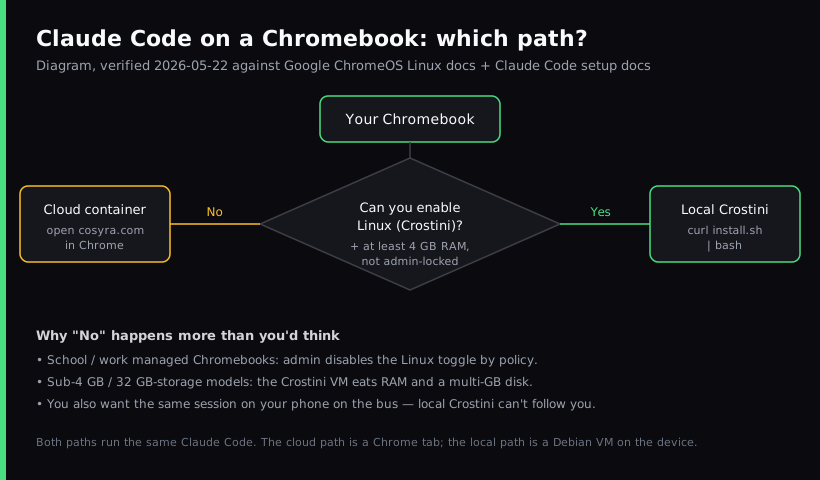
What are the two ways to run Claude Code on a Chromebook?
There are two real paths as of 2026-06-28. The first is local: ChromeOS ships an official Linux container called Crostini, and Claude Code installs inside it the same way it would on any Debian box. The second is cloud: you open a browser-based terminal and the agent runs on a server, with your Chromebook acting purely as the screen and keyboard. Which one is right depends on three things: whether Crostini is even available to you, how much RAM and storage your device has, and whether you want the same session on your phone later.
We have an opinion that a lot of "you need a real laptop to code" people will not like: a $250 Chromebook is a better client for agent-driven coding than it has any right to be, because the expensive part, the model, runs at Anthropic, not on the device. The Chromebook is rendering a terminal and applying diffs. We have done a full afternoon of refactoring from a library-loaner Chromebook on a wobbly reading-room desk, with the agent doing the work in a tab. The hardware almost does not matter once you accept that the compute is not local.
Path 1: Install Claude Code locally with Crostini
This is the path if your Chromebook supports Crostini, has at least 4 GB of
RAM, and is not locked down by a school or work admin. You get a real Debian
container with full apt, a home directory, and root inside the
VM. It is the most "normal laptop" experience.
Step 1: Turn on the Linux development environment
Open Settings → About ChromeOS → Developers and click Set up next to "Linux development environment." Give it at least 10 GB of disk if you have the storage to spare. ChromeOS downloads a Debian VM; Google's docs say setup can take 10 minutes or more. Two limits worth knowing before you start: the container has no GPU / hardware acceleration and no camera access, so it is a development shell, not a place to run accelerated workloads.
Step 2: Install Claude Code in the Debian container
Open the Terminal app that Crostini installs and run the native installer. Because the Crostini container is Debian, which uses glibc, the native binary runs directly. This is the key difference from Android's Termux, where the same binary fails against Bionic libc and you are forced onto an npm workaround. On a Chromebook, there is no workaround.
$ curl -fsSL https://claude.ai/install.sh | bash
Downloading Claude Code for linux-x64...
Installed to ~/.local/bin/claude
$ claude --version
Claude Code (latest)
The official setup docs list the requirements: Debian 10+ (Crostini ships Debian 12, Bookworm), Node.js 18 or later for the npm path, 4 GB of RAM, and an x64 or ARM64 processor. ARM Chromebooks are fine here. Crostini's Debian uses glibc on both architectures, so the libc problem that bites ARM Android never appears. Native installs auto-update in the background.
Since we first wrote this guide, Anthropic also started publishing a
signed apt repository, and on a Debian Crostini container that is the path we now reach for
first. It slots into the package manager Crostini already gives you, and
apt verifies the release signature for you. Add the key, add the
repo, install, and your normal apt upgrade keeps Claude Code current
(as of 2026-06-28):
$ sudo install -d -m 0755 /etc/apt/keyrings
$ curl -fsSL https://downloads.claude.ai/keys/claude-code.asc -o /etc/apt/keyrings/claude-code.asc
$ echo "deb [signed-by=/etc/apt/keyrings/claude-code.asc] https://downloads.claude.ai/claude-code/apt/stable stable main" | sudo tee /etc/apt/sources.list.d/claude-code.list
$ sudo apt update && sudo apt install claude-code
Setting up claude-code ...
The trade-off: the install script's binary auto-updates in the background,
while the apt package updates only when you run apt upgrade. We
think that is the right trade on a Chromebook you already keep patched with
the system, one update workflow, not two. The script path above is still
fine if you would rather not touch apt at all.
Step 3: Add your API key and run claude
Get a key from console.anthropic.com, persist it, and start a session in your repo:
$ echo 'export ANTHROPIC_API_KEY="sk-ant-your-key"' >> ~/.bashrc
$ source ~/.bashrc
$ git clone https://github.com/your-org/app.git
$ cd app && claude
Claude Code (latest)
> Find the flaky test and propose a fix.
- Works when: Crostini is available, you have 4 GB+ RAM and spare storage, and you want a free local environment you fully control.
- Breaks when: an admin disabled Linux, your device has under 4 GB of RAM or a 32 GB eMMC that the VM eats into, or you want the same session waiting on your phone later, since a local container cannot follow you off the device.
- Cost: free (you still pay Anthropic for API usage).
Path 2: Run Claude Code in Chrome with Cosyra
This is what we build, and it is the path when the local route is blocked or
not worth the disk. A Chromebook is, above everything, an excellent browser.
We lean into that: open cosyra.com in Chrome, sign in, and you get
a persistent Ubuntu 24.04 container on Azure with Claude Code, Codex CLI, OpenCode,
and Antigravity CLI already installed. No VM on the device, no
apt, no admin toggle to fight. The same container is reachable
from the Cosyra app on iPhone and Android, so the session you start on the
Chromebook in the library is the one waiting on your phone on the bus home.
We think this is the right default for the typical Chromebook: the device stays a thin, cheap, replaceable screen, and the environment lives somewhere durable. The honest cost of that is real: there is no offline mode. The container is in the cloud, so no internet means no terminal. A local Crostini build keeps its files on the device. (Though even local Claude Code needs the network to reach the model, so "offline coding with an AI agent" is mostly a myth either way.)
Try it from your Chromebook. Open cosyra.com in Chrome, or grab the app. Sign up and pick a plan, from $20/month. Google Play / App Store / Pricing details
What about a school or work managed Chromebook?
This is the single most common Chromebook coding wall, and it is worth naming plainly. On a managed device, an admin can disable the Linux development environment by policy. The Set up button is greyed out or gone, and no amount of clicking changes that. It is enforced from the Admin console, not your settings. Search the ChromeOS support forums and you will find thread after thread of students hitting exactly this.
Do not try to bypass device management. On a school or work device, that can violate policy and get you in real trouble. The two legitimate moves are: ask your admin to enable Crostini (they can do it centrally, and for a CS class they often will), or use a browser-based environment that needs no device changes at all. A cloud terminal you open in a Chrome tab is exactly that, just a website, so the Linux policy never enters into it. For the broader set of browser-based options, see our pillar on mobile cloud terminal solutions.
How do the Chromebook options compare?
The two paths line up cleanly against what matters: whether you need an admin's permission, how much device RAM and storage they want, whether the session follows you to a phone, and what happens with no internet. Here is the side-by-side as of 2026-06-28.
| Factor | Local Crostini | Cosyra (Chrome / app) |
|---|---|---|
| Setup | Enable Linux + install (~15 min) | Open cosyra.com, sign in (~1 min) |
| Works on managed Chromebook | No (admin can disable Linux) | Yes (it is just a website) |
| Container OS | Debian 12 (glibc) | Ubuntu 24.04 x86_64 |
| AI CLIs pre-installed | No (you install Claude Code) | Yes (Claude Code, Codex, OpenCode, Antigravity) |
| RAM / storage on device | 4 GB+ RAM, several GB disk | Minimal (a browser tab) |
| Persistent storage | On device (your eMMC) | 30 GB in the cloud |
| Same session on your phone | No | Yes (iOS + Android apps) |
| Works offline | Files yes, model no | No |
| Cost | Free + your API usage | From $20/mo + your API usage |
Choose local Crostini if you own the Chromebook, it has the RAM and storage, and you want a free environment with files on the device. Choose Cosyra if your Chromebook is managed, low-spec, or you want the same container on your phone and in a browser without any local setup. If you are weighing a remote SSH box instead, our SSH from your phone guide covers why a managed container usually beats babysitting your own server.
Frequently asked questions
Can I run Claude Code on a Chromebook?
Yes, two ways. Locally inside the Crostini Linux container with the native installer, or in a browser via a cloud terminal like Cosyra. One developer reported running Claude Code with the Opus 4.5 model on a 4 GB Chromebook with no throttling, so even budget hardware works.
[source: DEV, "Vibe Coding on a 4GB RAM Chromebook?"]
How do I enable Linux (Crostini) on a Chromebook?
Settings → About ChromeOS → Developers → Set up next to "Linux development environment." ChromeOS downloads a Debian VM and setup can take 10 minutes or more. The container has no GPU acceleration or camera access, but a terminal and Node-based CLIs run fine.
[source: Google Chromebook Help, "Set up Linux on your Chromebook"]
Can I run it on a school or work managed Chromebook?
Often not locally. Admins can disable the Linux development environment by policy, and the Set up button is greyed out. Ask your admin to enable it, or use a browser-based cloud terminal that needs no device changes. Cosyra runs in a Chrome tab, so the Linux policy does not apply.
[source: ChromeOS Community, "Linux on a school Chromebook that has blocked things"]
Is a Chromebook powerful enough for serious development?
For agent-driven work, more than the spec sheet implies. The model runs at Anthropic, so the device mostly renders a terminal. A 4 GB Chromebook handles a session. For a heavier local Crostini build, an Intel i3 / 8 GB / 64 GB device is the comfortable floor.
[source: Hacker News, "Ask HN: Are Chromebooks ready for serious development?"]
What is Crostini, and does the VM slow things down?
Crostini is the official ChromeOS Linux development environment: a Debian container in a lightweight VM, isolated from ChromeOS for security. A Crostini engineer described it on Hacker News as a full Linux VM. There is a small isolation cost and no GPU, but for a terminal and Node CLIs it is unnoticeable.
[source: Hacker News, comment from a Crostini developer]
Should I use the native installer, apt, or npm on a Chromebook?
Three working options as of 2026-06-28. The signed apt repository (sudo apt install claude-code) fits Crostini best. It uses the package manager you already have and
apt verifies the release signature. The native installer (curl -fsSL https://claude.ai/install.sh | bash) is simplest and auto-updates in the background. The npm package needs
Node.js 18+. All three work because Debian uses glibc. The libc mismatch
that breaks the binary on Android's Termux does not apply on ChromeOS.
tl;dr
Two ways to run Claude Code on a Chromebook as of 2026-06-28. Local:
enable the Linux development environment (Crostini), then
curl -fsSL https://claude.ai/install.sh | bash, free, on
device, needs 4 GB+ RAM and an unlocked Linux toggle. Cloud: open
cosyra.com in Chrome for a ready-made Ubuntu container with Claude
Code pre-installed. Works on managed and low-spec Chromebooks, and the same
session follows you to your phone.
Google Play / App Store / Pricing. Sign up and pick a plan, from $20/month.
Code on your Chromebook in a Chrome tab. No VM, no admin toggle, no install. Claude Code pre-installed in a cloud container.