Short answer. Cosyra vs Goose is not really agent-vs-agent; it's two different shapes. goose is a free, open-source (Apache-2.0) AI agent that runs on a machine you host; its free iOS app, "Goose AI," is a remote control that tunnels back to that machine, and there's no Android app on the Play Store yet (2026-07-11). Cosyra is a paid mobile cloud terminal: a per-user Ubuntu 24.04 container with Claude Code, Codex CLI, OpenCode, and Antigravity CLI pre-installed, reached from native iOS and Android apps. Pick goose if you already keep a powerful machine on around the clock and want a fully self-hosted, $0 stack. Pick Cosyra if you'd rather not own, power, and patch a home server just to code from your phone.
We wrote this after doing the thing the comparison is actually about: we installed goose itself inside a Cosyra container with the official curl installer and ran a session from the iOS app, on the couch, with the laptop shut. Because goose is Apache-2.0 with a prebuilt x86_64 binary, the real agent runs in the cloud container, not as a remote control pointed at a box at home. That's the whole story of this page: same agent, very different place for it to live.
This post was written by the Cosyra team. We compared Cosyra against goose based on hands-on testing of both (installing the goose CLI inside our container, reading the aaif-goose/goose and goose-mobile READMEs first-hand, and checking the App Store listing) plus our internal goose factsheet. Claims and versions verified 2026-06-11.
tl;dr
Use goose if you want a fully open-source, self-hosted agent, you run local models, or you already keep a machine on 24/7 and want a $0 monthly stack. Use Cosyra if you don't want a home server and a tunnel to babysit and you want a native iOS or Android app with agents pre-installed. They solve different problems, and you can run goose inside Cosyra.
App Store · Google Play. Sign up and pick a plan. Eligible new users can start a 7-day free trial in the App Store app.
Want goose running without a home server? Our container is the always-on Linux machine goose's agent needs. Install the goose CLI with one curl command, or use the four agents we pre-install, all reached from a native iOS or Android app.
App Store · Google Play · Pricing. Sign up and pick a plan, from $20/month.
How do Cosyra and Goose compare feature by feature?
Cosyra is a cloud Ubuntu container reached from native iOS and Android apps with AI agents pre-installed; goose is a free, open-source agent you run on a machine you supply, with a free iOS remote-control app and no Android app yet. Cosyra starts at $20/month and that price is the always-on machine; goose's software is free but assumes you already own, power, and patch an always-on host plus set up a tunnel. The table below lines them up on thirteen attributes, verified 2026-06-11.
| Feature | Cosyra | goose |
|---|---|---|
| Pricing | $20 / month Core or $30 / month Pro | Free software (Apache-2.0); you pay your own host + LLM |
| Free tier | None. 7-day free trial for eligible new users in the App Store app | Free forever (software + iOS app) |
| OS support | iOS, Android, web | macOS, Linux, Windows (agent); iOS remote app; no Android app |
| AI agents pre-installed | Claude Code, Codex CLI, OpenCode, Antigravity CLI | goose is the agent; model-agnostic, BYO LLM |
| Where the agent runs | In the cloud container; phone is a terminal | On a machine you host; iOS app tunnels in |
| Persistent storage | 30 GB cloud, survives device loss | On your host machine; you manage it |
| Offline capability | No (cloud-only) | Yes, if your host is local and offline-capable |
| Container / sandboxing | Per-user Ubuntu container on Azure AKS | Runs in your host's user space; you sandbox it |
| Remote reach from phone | Built-in HTTPS, native apps, no tunnel | Cloudflare tunnel to your host (iOS app) |
| File sync across devices | Same container from any device | Tied to your host; sync is on you |
| Max session length | Hibernates on idle, resumes on reopen | As long as your host stays on |
| API key model | BYOK (you pay Anthropic / OpenAI / Google) | BYOK, model-agnostic, local models supported |
| Open-source status | Client app closed, orchestration proprietary | Open source, Apache-2.0, github.com/aaif-goose/goose |
Want the cloud side of this comparison?
We ship a persistent Ubuntu container with four agents pre-installed, plus you
can curl … | bash goose into it too, on iOS and Android, in about
two minutes.
App Store · Google Play · Pricing. Sign up and pick a plan. Eligible new users can start a 7-day free trial in the App Store app.
What does each stack actually require?
The headline "$0 vs $20" is misleading until you write down everything each side needs to get an agent answering prompts from your phone. goose's software is free, and so is the iOS app, but the agent has to run somewhere, and that somewhere is a machine you own and keep powered on, fronted by a tunnel. Cosyra's $20/month is that machine, plus the storage and the native apps, with the reach already wired up.
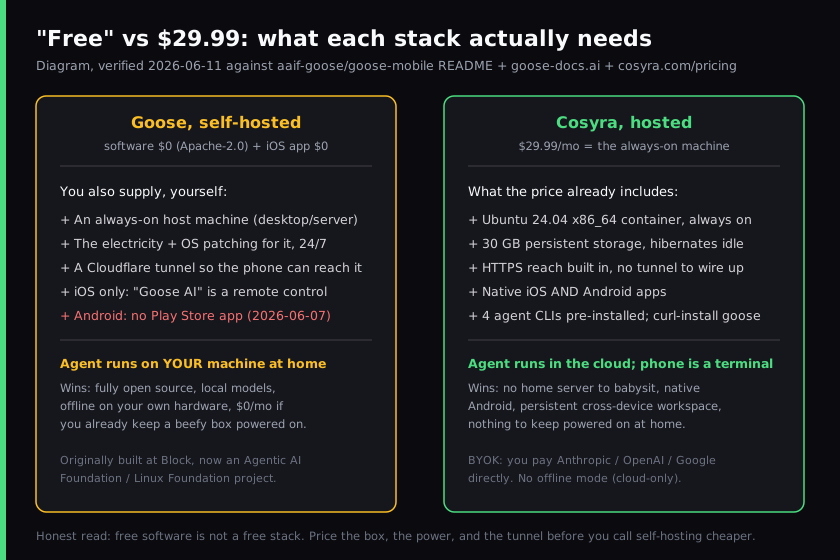
What happened when we ran goose inside a Cosyra container?
It just worked, and that's the interesting part. goose is not one of the four agents we pre-install, so we added it ourselves with the official installer. The whole point: the agent ran in the cloud container, reachable from the iOS app, with no machine running at home and no tunnel to configure. Here's the session we ran on a fresh container.
$ uname -m
x86_64
$ # goose ships a prebuilt x86_64 binary, no compile step
$ curl -fsSL https://github.com/aaif-goose/goose/releases/download/stable/download_cli.sh | bash
$ goose --version
goose 1.37.0
$ goose configure # pick a provider, paste your own key (BYOK)
$ goose session
starting session | provider: anthropic
( O)> refactor the retry backoff to add jitter
The contrast with goose's own mobile path is the comparison in a sentence.
With the Goose AI iOS app, that same goose session would be running
on a desktop or server you keep on at home, and the phone would be tunneling
in over HTTPS. With Cosyra, there is no machine at home; the container is the
host, it hibernates when idle and resumes where it left off, and you reach it
the same way from an iPhone, an Android tablet, or the web. We did this on the
couch with the laptop shut, which is exactly the case goose's remote app is built
for, except we didn't need the laptop on.
Where does goose beat Cosyra?
goose beats Cosyra on open-source ownership, true local execution, model choice including local models, and cost if you already run an always-on machine. We ship a managed cloud product and we still think goose is an excellent piece of software for the right person. Here's where it's the better pick, with the receipts.
- Fully open source and self-hostable. goose is Apache-2.0, so the whole stack is yours to read, fork, and run on your own terms. The source lives at github.com/aaif-goose/goose, and it's governed under the Agentic AI Foundation at the Linux Foundation, not a single vendor. Cosyra's orchestration is proprietary. If "I can audit and own the entire thing" matters to you, goose wins outright.
- Truly local and offline on your own hardware. Because the agent runs on a machine you control, your code never has to leave it, and it keeps working with no internet if your host and model are local. Our container is in the cloud; lose signal and the terminal stops. For air-gapped or privacy-strict work, goose is the honest answer, not us.
- Model-agnostic, including local models. goose is BYO-LLM out of the box and runs against local models, so you can keep inference entirely on your own machine. We're also BYOK, but our agents call hosted providers; we don't ship a local-model story.
- $0/month if you already keep a machine on 24/7. If you have a workstation that's always powered anyway, goose's free iOS app is a genuinely free way to check on a long-running agent from your phone. There's no monthly bill to add. The README documents the iOS client and the goose-mobile remote protocol openly.
Where does Cosyra beat goose?
Cosyra beats goose on not needing a home server, native Android support, a persistent cloud workspace that follows you across devices, and zero tunnel setup. The trade-off for "free and fully self-hosted" is that you become the sysadmin of an always-on box. We'd rather be that sysadmin for you.
No home server to babysit
goose-on-phone, done goose's way, needs a separate always-on machine plus a Cloudflare tunnel. That machine is your responsibility to power, patch, and keep reachable. Our container is the always-on Linux machine, in the cloud, reached from a native app with nothing running at home. The one evening a quarter you'd spend debugging why the tunnel dropped mid-commute is an evening we spend instead of you.
Native Android, not just iOS
goose has a free iOS remote app, but there's no Android app on the Play Store as of 2026-07-11, only a work-in-progress port. If you carry a Pixel or a Galaxy, goose's mobile story doesn't cover you yet. We ship a native Google Play app backed by the same container you use on iPhone, and a dedicated guide for running goose on Android through the container path.
The agent runs in the cloud, and it can be goose itself
On first boot our container already has Claude Code, Codex CLI, OpenCode, and Antigravity CLI on the PATH. And because goose is Apache-2.0 with an official curl installer, you can drop goose's own agent into the same container in one command, as we did above. The same one-command move works for other terminal agents built the same way. Kilo CLI installs from npm and runs in that container too. So Cosyra can host goose's agent, not just a remote control pointed at a box at home. Our full walkthrough is in Run goose on your phone.
Persistent workspace across devices, no tunnel
A Cosyra container persists in the cloud and is the same container whether you reach it from an iPhone, an Android tablet, or a laptop browser. Drop your phone, buy a new one, log in, and your repo, your shell history, and your half-finished agent session are still there. With goose, state lives on whichever machine you host the agent on, and exposing it to your phone means standing up and maintaining a tunnel.
An opinion goose's crowd will push back on
We think "self-hosted and free" quietly costs more than $20/month once you price in the electricity, the OS patching, and the one evening a quarter you lose to a dropped tunnel while you're on the train. The self-hosting crowd will disagree, and for a homelab hobbyist who enjoys that maintenance, they're right to. But for someone who just wants an agent answering prompts from their phone between meetings, "free" software sitting on a box you babysit is not the cheap option it looks like. That's the exact reason we built Cosyra as a hosted container instead of shipping yet another self-hosted agent.
Who should pick goose instead of Cosyra?
Pick goose instead of Cosyra if you're a self-hosting believer, a local-model user, or someone who already keeps a powerful machine on around the clock. For those three profiles goose is the better tool, and we'd tell you so. We run goose on one of our own machines for exactly this reason.
Try goose first if you are one of these profiles
- Self-hosting believer. You want to own the whole stack, audit the source, and avoid a managed cloud service on principle. goose is Apache-2.0 and self-hostable end to end. That's the right answer for you, full stop.
- Local-model user. You run inference on your own hardware and want the agent to do the same, with nothing leaving the building. goose is model-agnostic with local-model support; our agents call hosted providers.
- You already have an always-on machine. If a workstation or home server is already humming 24/7, goose's free iOS app lets you check on long-running tasks from your phone at zero extra monthly cost. Setting up the tunnel once is a fair trade if the box is already there.
We use goose on a machine we already keep running, and we use Cosyra when we want an agent on a phone with no machine at home to think about. They aren't mutually exclusive, and since you can install goose inside a Cosyra container, the line between them is thinner than it looks.
How do you try Cosyra if you're coming from goose?
You try Cosyra from a goose background in about two minutes: install from the App Store or Google Play, sign in, and you land in a fresh Ubuntu 24.04 x86_64 container instead of a box you host yourself. Your four agents are already on the PATH, and if you want goose specifically, it's one curl command away. The session below is what we run on a fresh install.
$ # Install Cosyra, open the app, drop into the container.
$ cat /etc/os-release | head -1
PRETTY_NAME="Ubuntu 24.04 LTS"
$ which claude codex opencode agy
/usr/local/bin/claude
/usr/local/bin/codex
/usr/local/bin/opencode
/usr/local/bin/agy
$ # Want goose too? One command, runs in this container.
$ curl -fsSL https://github.com/aaif-goose/goose/releases/download/stable/download_cli.sh | bash
$ goose configure && goose session
The big unlock for most people coming from goose: there's no home server in the picture anymore. The container is the always-on machine, it hibernates when idle and resumes where you left off, and you reach it the same way from any device with no tunnel to maintain.
Frequently asked questions
Is there a Goose mobile app?
Yes on iOS, no on Android (as of 2026-07-11). There is a free iOS app called "Goose AI" (App ID 6752889295). On Android there is no Play Store app yet, only a work-in-progress client port. The goose-mobile README says the iOS client "is available to use via the apple app store" and that a Google Play client "will be available ... eventually."
[source: aaif-goose/goose-mobile README on GitHub]
Does the Goose iOS app run the AI agent on my iPhone?
No. The Goose AI iOS app is a remote control, not an on-phone agent. The goose-mobile README describes the iOS client as a "remote protocol to access the goose agent which connects back to your goose agent from anywhere, via a tunnel." The agent and the model run on a machine you host; the phone tunnels in over HTTPS via a Cloudflare tunnel.
[source: aaif-goose/goose-mobile README]
Can I run goose on Android?
Not as a native app yet. As of 2026-07-11 there's no Goose Android app on the Play Store, only an early WIP port and an experimental on-device automation proof of concept. The practical path today is to install the goose CLI inside a cloud Ubuntu container and reach it from a native app, which we walk through in our goose-on-phone guide.
[see: Run goose on your phone, the container setup]
Is goose free and open source?
Yes. goose is licensed Apache-2.0 (see the LICENSE in the aaif-goose/goose repo), and both the software and the iOS remote app cost $0. You pay only for your own LLM provider key, it's BYOK and model-agnostic, and for whatever it costs to keep your host machine powered on. The whole stack is auditable and forkable.
[source: Apache-2.0 LICENSE, aaif-goose/goose]
Is goose a Block product?
It originated at Block but isn't a Block product in the present tense. The project moved from block/goose to the Agentic AI Foundation at the Linux Foundation; the old block.github.io/goose docs now redirect with a "goose has moved" notice. Correct phrasing: "originally built at Block, now an Agentic AI Foundation / Linux Foundation project."
Do I need to keep a computer running to use goose from my phone?
With goose's own apps, yes. The iOS remote control tunnels to a goose agent running on a machine you host and keep on 24/7, plus a Cloudflare tunnel to expose it. A hosted cloud container removes that: the container is the always-on machine, reachable from a native app with no home server and no tunnel. That's the core difference between the two stacks.
[source: goose-mobile README, tunnel + remote-control design]
Four agents pre-installed, and goose is one curl away. We run them in a real x86_64 Ubuntu container, reached from a native iOS or Android app, with no home server and no tunnel. Two-minute setup.
Run goose on your phone · Goose on Android · AI coding agents on mobile · See pricing. Sign up and pick a plan. Eligible new users can start a 7-day free trial in the App Store app.