If you searched for a Daytona alternative for humans, you probably noticed something off about the listicles: they all name AI sandbox tools like E2B, Modal, and microsandbox, none of which you can open and code in. That is because Daytona pivoted to an AI sandbox runtime in April 2025 and dropped the dev-environment-manager product people used to compare with GitHub Codespaces. So "Daytona alternative" now has two answers. If you want Daytona's current job, the sandbox tools are right. If you wanted the old product, a box a person sits in and codes, the real alternatives are Codespaces, Gitpod (now Ona), Coder, and Cosyra. And only the last one ships a native phone app.
This guide is for the second group: developers who landed on a "Daytona alternatives" page expecting a Gitpod-style coding environment and found a list of agent-runtime SDKs instead. We cover why the question splits in two, the four honest human-facing alternatives with dated facts, where each wins, and how to get the one that actually works from a phone. For the wider map see the cloud IDE on phone pillar, and for the narrower "is Daytona usable on a phone" version see Daytona on a phone.
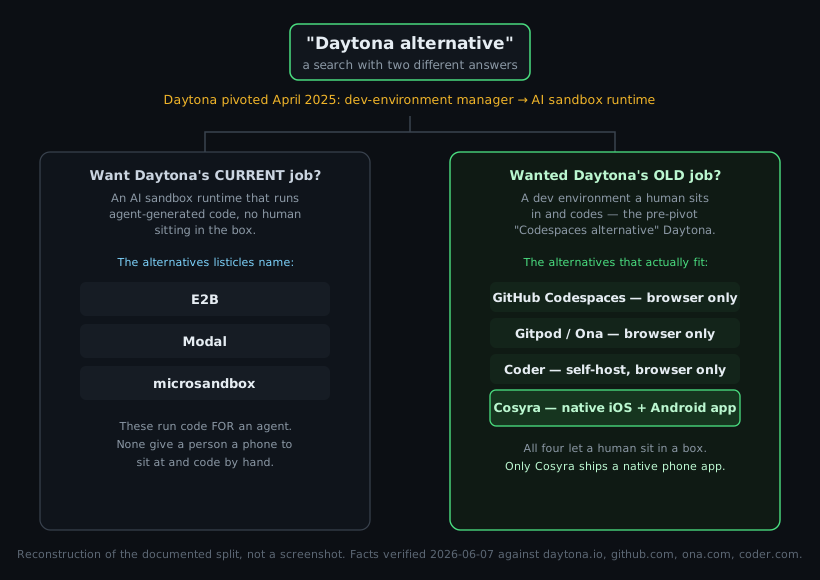
Why "Daytona alternative" has two different answers
In March 2024 InfoQ described Daytona as a Development Environment Management tool and an "enterprise-grade Codespaces alternative." That is the Daytona most people remember: one command spins up a fully configured workspace you sit in and write code. It was a reasonable thing to want from a phone, if it had ever shipped a mobile client.
Then the company changed direction. Daytona's homepage now reads, verbatim
as of 2026-07-01, "Secure and Elastic Infrastructure for Running Your
AI-Generated Code." The
public core repo (AGPL-3.0,
about 72,325 stars when we checked on 2026-07-01) is a sandbox runtime: your agent
calls daytona.create(), runs generated code in an isolated
container, reads the result, and tears it down. As of June 2026 that repo
also stopped moving. A banner on it says core development moved to a private
codebase and the public repo will get no further updates, with v0.190.0
(2026-06-23) the final open release. Daytona's own design phrase is that it
"assumes no one is watching." A human has no seat in that loop, so a phone
has no seat either.
That makes the search ambiguous. "Daytona alternative" means one thing if you want a runtime to execute agent-written code, where E2B, Modal, and microsandbox are the right names. It means a completely different thing if you wanted the box you sit in. We think the up-to-date listicles owe their readers that distinction and mostly skip it, which is why a developer who just wants to open a terminal and type ends up on a page full of SDKs that cannot help. Daytona's own market would say humans simply are not the customer anymore. We disagree that the human use case stopped mattering. It moved, mostly onto the phone in your pocket on the train, and somebody still has to serve it.
The four human-facing alternatives, with dated facts
These are the products that still let a person open an environment and code in it, the pre-pivot Daytona use case. Facts below were verified first-hand on the dates given; we keep a longer Codespaces comparison and a Coder comparison if you want the deep versions.
GitHub Codespaces
The closest like-for-like replacement for old Daytona's "Codespaces alternative" framing is, fittingly, Codespaces itself. It is a closed-source managed service: an Ubuntu dev container per repo, one-click spin-up, accessed from the browser or VS Code desktop. GitHub Free includes 120 core-hours plus 15 GB of storage a month and Pro includes 180 core-hours plus 20 GB (verified 2026-06-05 against the features page); pay-as-you-go starts at $0.18/hour for a 2-core machine. The honest gap for a phone: there is no native iOS or Android app. GitHub's own pitch is "want to code on an iPad? Go for it," but that means mobile Safari rendering desktop VS Code, and the file tree and terminal are cramped on a phone-sized screen.
Gitpod, now Ona
Gitpod rebranded to Ona on 2025-09-02 and re-centered on autonomous background agents ("task in, pull request out"). The browser VS Code IDE still ships underneath, so it remains a real human dev environment, but it is no longer the headline. Pricing moved to credit-based OCUs: as of 2026-07-04 there is no free tier, the entry plan is Core from $20/month metered by usage, and the old $10 / 40-OCU figure is now a paid add-on for extra OCUs, not a free credit (re-verified 2026-07-04 against ona.com/pricing). It has never shipped a native app of any kind; the only mobile artifact is an unofficial community side-project, not a published client. On a phone you are again in a browser tab.
Coder
Coder is the self-hosted option. The flagship coder/coder platform
is AGPL-3.0 (about 13,702 stars, latest release v2.33.11 on 2026-06-30, verified
2026-07-04), and you run the control plane in your own AWS, Azure, GCP, or Kubernetes.
The Community edition is genuinely free and open source, but the cost is your
own cloud bill plus the operational work; the Premium per-seat price is not published.
Coder ships no native mobile client either: its
own pricing page gates Premium behind
a trial, and its official iOS documentation hands iPhone users off to the iSH
emulator or a browser PWA. It wins decisively on air-gap and self-hosting, which
none of the others, including us, can match.
Cosyra
This is what we build, and the reason it belongs on a human-alternatives list is the native app. The Cosyra iOS and Android apps give you a persistent Ubuntu 24.04 container with Claude Code, Codex CLI, OpenCode, and Gemini CLI already installed, 30 GB of storage, and hibernation that resumes exactly where you left off. Pricing is a flat $29.99/month for 120 hours of compute. The same container is reachable from iPhone, Android, and web, so we start a task on a phone on the couch and pick it up on a laptop later without re-cloning anything. We have no self-hosting, no GPUs, and no offline mode, which we cover honestly below. If you are weighing the pre-pivot Daytona against a cloud box you actually sit in, we put the two side by side in Cosyra vs Daytona.
The alternatives side by side
Lined up against what a human coding from a phone actually needs, a native app, a box you sit in, and a price you can predict, the options sort out cleanly. Verified 2026-06-07.
| Tool | Native phone app | Human sits in the box | Pricing shape |
|---|---|---|---|
| Daytona (today) | No | No (agent-driven SDK) | Per-second metering |
| GitHub Codespaces | No (browser only) | Yes | Free tier + $0.18/hr PAYG |
| Gitpod / Ona | No (browser only) | Yes | $10 once, then $20/mo OCU |
| Coder | No (browser / iSH) | Yes (self-hosted) | Free OSS + your cloud bill |
| Cosyra | Yes (iOS + Android) | Yes | Flat $29.99/mo |
Who should pick which
Here is the decision framework we would give a friend.
- If you actually wanted Daytona's current job, a runtime to execute agent-generated code, stop reading lists of human IDEs and go look at E2B, Modal, or microsandbox, or stay on Daytona itself. A mobile dev environment is not what you need.
- If you live in GitHub and code mostly from a laptop with the occasional iPad session in a browser, Codespaces is the lowest-friction pre-pivot-Daytona replacement and the free tier is generous.
- If you want self-hosting or air-gap, Coder is the answer and the others, us included, cannot match it. Be ready to own the cloud bill and the ops.
- If the device in your hand is a phone and you want a real terminal with AI coding CLIs you drive yourself, pick Cosyra. The native app is the whole point: you are typing short prompts and reviewing diffs, which thumbs handle fine in a waiting room.
One honest gap on our side worth stating plainly: Cosyra has no offline mode. The container lives in the cloud, so no signal means no terminal. If you code primarily on long flights with no Wi-Fi, none of these cloud options is your tool and a local setup wins. For everywhere with a connection, the cloud box is the trade we happily make.
How to get the phone-first alternative running
The pattern that works on a phone is the one Daytona retired: a native app talking to a persistent cloud Linux container you sit in and drive yourself. Here is the three-minute setup.
Step 1: Install Cosyra from the App Store or Google Play
Open the App Store on iPhone or Google Play on Android and install Cosyra. Sign in with Apple, Google, or email. The app provisions a fresh Ubuntu container on first launch. Sign up, 1 hour free, no credit card. Extend with a 10-hour, 7-day trial when you want more.
Step 2: Add your model API key
Cosyra is bring-your-own-key, so you pay Anthropic, OpenAI, or Google directly rather than through us. In the terminal:
$ # Persists across sessions and device switches
$ echo 'export ANTHROPIC_API_KEY="sk-ant-your-key-here"' >> ~/.bashrc
$ source ~/.bashrc
$ claude --version
Claude Code (latest)
Step 3: Run an agent in a box you sit in
Clone a repo and start a session:
$ git clone https://github.com/your-org/your-project.git
Cloning into 'your-project'...
$ cd your-project
$ claude
Claude Code (latest)
Type your prompt, or type "/" for commands.
> Add a health-check endpoint and a test, then run the suite.
Try it on your phone. Sign up, 1 hour free, no credit card. Extend with a 10-hour, 7-day trial when you want more. App Store / Google Play / Pricing details
Frequently asked questions
Is Daytona still a Codespaces or Gitpod alternative?
Not for a human developer. Daytona started as a self-hosted Development Environment Manager and was fairly compared to GitHub Codespaces before 2025. It pivoted to an AI sandbox runtime, announced in its "From Dev Environments to AI Runtimes" post in April 2025, and its homepage now reads "Secure and Elastic Infrastructure for Running Your AI-Generated Code." If you want the old "open a workspace and code in it" product, the current Daytona is no longer it.
[source: "From Dev Environments to AI Runtimes", daytona.io]
Why do "Daytona alternative" lists only name AI sandbox tools?
Because the up-to-date ones track the current product. Daytona today is a runtime for executing agent-generated code, so listicles compare it to E2B, Modal, and microsandbox. That is correct if you want Daytona's current job. It is the wrong list if you wanted the pre-pivot dev environment a person sits in, which is what "Daytona alternative for humans" is really asking.
[source: "Redefining the agent experience", daytona.io]
What is the best Daytona alternative for a human who sits and codes?
For a person at a keyboard the honest shortlist is GitHub Codespaces (browser plus VS Code desktop), Gitpod, now rebranded to Ona (browser VS Code), Coder (self-hosted, browser), and Cosyra (a native iOS and Android app on a persistent cloud Linux box). All four put a human back in the loop. Only Cosyra ships a native phone app, which matters if the device in your hand is a phone.
[source: Cosyra pricing and features]
Is there a free Daytona alternative for a real dev environment?
Several, with different shapes. GitHub Free gives 120 Codespaces core-hours plus 15 GB per month (verified 2026-06-05). Coder's Community edition is free and open source under AGPL-3.0, but you pay your own AWS, Azure, or GCP bill for the workspace machines (verified 2026-07-04). Cosyra gives 1 hour free on signup with no credit card, then an opt-in 10-hour, 7-day trial.
[source: GitHub Codespaces features page]
Can I get a Daytona-style dev environment on my phone?
Not from Daytona, which ships no mobile app and whose dashboard is operational rather than an editor. Codespaces, Gitpod/Ona, and Coder are browser-only, so on a phone you are squinting at desktop VS Code in a tab. The setup built for a phone is a native app talking to a persistent cloud Linux container you drive yourself, which is what we build at Cosyra.
[source: Daytona on a phone, current state]
Are E2B and Modal the same kind of tool as the old Daytona?
No. E2B and Modal are sandbox and serverless-compute runtimes for AI-generated code, the same category Daytona moved into after its 2025 pivot. They are good alternatives to the current Daytona. They are not dev environments you open and code in by hand, so they do not replace the pre-pivot Daytona that people remember.
tl;dr
Daytona pivoted to an AI sandbox runtime in 2025, so "Daytona alternative" now means two things. If you want that current job, use E2B, Modal, or microsandbox. If you wanted the pre-pivot dev environment a human sits in, the real alternatives are GitHub Codespaces, Gitpod (now Ona), and Coder, all browser-only, plus Cosyra, the only one with a native iOS and Android app and four AI coding CLIs pre-installed.
App Store / Google Play. Sign up, 1 hour free, no credit card. Extend with a 10-hour, 7-day trial when you want more. See pricing.
For the wider picture, our cloud IDE on phone pillar benchmarks every browser-based IDE you might open from a phone, and the mobile coding terminal pillar covers the terminal-on-a-device decision end to end. The same "this product pivoted or never shipped a mobile app, here is the honest current state" pattern shows up across the cluster: the narrower Daytona on a phone guide, and Gitpod on iPad for the Ona rebrand in detail.
Get a real dev environment on your phone in 3 minutes. Install Cosyra, add your API key, run an agent in a persistent Ubuntu container.