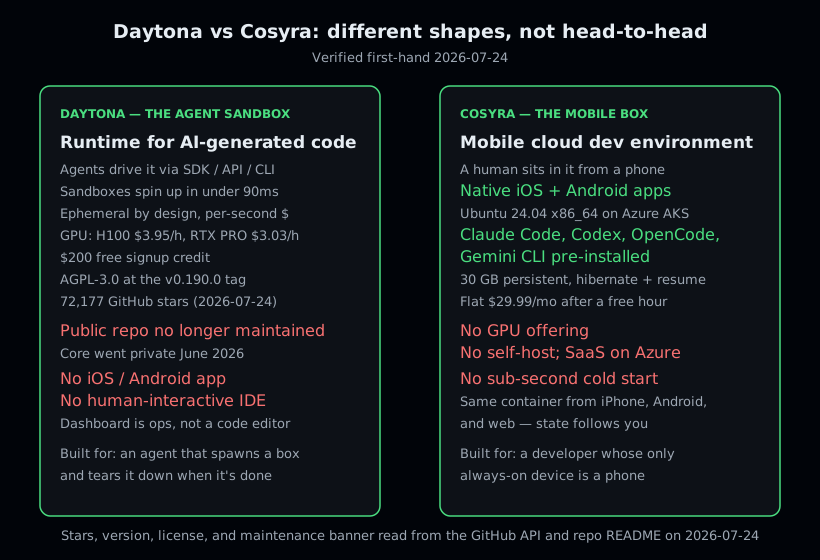
Short answer. Cosyra vs Daytona is two different shapes, not a head-to-head. Daytona pivoted in April 2025 from a dev-environment manager to an AI-agent sandbox runtime: an agent spins up an isolated Linux sandbox via SDK or API, runs generated code, and tears it down. It has no mobile app and no human-interactive IDE. Cosyra is a hosted Ubuntu 24.04 container you reach from native iOS and Android apps, with Claude Code, Codex CLI, OpenCode, and Antigravity CLI pre-installed. If you are building an agent that needs a sandbox, use Daytona. If the device in your hand is a phone and you want to sit in a shell, we think Cosyra is the better fit.
We wrote this after using both the way each is meant to be used: Daytona driven programmatically to run code in a throwaway sandbox, and Cosyra opened from an iPhone on a train platform to sit in a real shell. Both are good at their own job. Only one of them is built for a human coding from a phone.
Quick decision: pick the path that matches your situation:
- I want the feature-by-feature breakdown → 13-attribute comparison table for 2026
- I want to know where Daytona genuinely wins → five things Daytona does better, with sources
- I'm leaning toward Daytona. Am I right? → honest decision framework (with a "try Daytona first if…" subsection)
- I want a real terminal on my phone today → two-minute Cosyra setup on iOS or Android
tl;dr
Use Daytona if you are building an AI agent that needs a secure, ephemeral sandbox to run generated code, with GPU access, sub-90ms cold starts, and per-second billing for bursty workloads. Use Cosyra if you are a developer who wants to sit in a Linux container from a phone, with agent CLIs already installed and a workspace that follows you across devices. Different tools for different jobs.
App Store · Google Play. Eligible new users can start a 7-day free trial in the App Store app.
This post was written by the Cosyra team. We compared Cosyra against Daytona based on hands-on testing of both. We drove Daytona through its SDK/CLI the way it is meant to be used, and ran Cosyra on iPhone and Android, alongside first-hand reads of the Daytona GitHub repository via the GitHub API, its README, the pivot announcement, and the daytona.io pricing page. Daytona facts, version numbers, and the June 2026 repository-maintenance banner were re-verified first-hand on 2026-07-24 (v0.190.0, 72,177 stars).
Came here to code on Daytona from your phone and found there's no app? We ship a persistent Ubuntu 24.04 container with Claude Code, Codex CLI, OpenCode, and Antigravity CLI pre-installed, reached from a native iOS or Android app. Open the app, land in a shell, start coding. Two-minute setup.
App Store · Google Play · Pricing. Sign up and pick a plan. Eligible new users can start a 7-day free trial in the App Store app.
How do Cosyra and Daytona compare feature by feature?
The core difference in Cosyra vs Daytona is who is at the keyboard. Cosyra is a box a human sits in from a phone; Daytona is a box an agent spawns through code. Cosyra is hosted, persistent, and flat-priced; Daytona is ephemeral, programmatic, and metered per second. The table below lines them up on thirteen attributes as of 2026-07-24.
| Feature | Cosyra | Daytona |
|---|---|---|
| Pricing | $20 / month Core or $30 / month Pro | Per-second usage-based; vCPU $0.0504/h, mem $0.0162/GiB-h |
| Free tier | None. 7-day free trial for eligible new users in the App Store app | $200 free signup credit, then metered |
| OS support | iOS, Android (native apps), plus web | Linux sandboxes only; no mobile app, no desktop app |
| AI agents pre-installed | Claude Code, Codex CLI, OpenCode, Antigravity CLI in the container | None; blank Linux base image, integrations are your code |
| Persistent storage | 30 GB per user, hibernates and resumes in place | Ephemeral by design; snapshots for chained agent tasks |
| Offline capability | No: the container is in the cloud, needs a network | No: cloud runtime driven over the network |
| Container sandboxing | Per-user isolated Ubuntu 24.04 container on Azure AKS | Isolated per-task sandboxes, sub-90ms cold start |
| GPU access | No GPU offering | Yes: H100 $3.95/h, RTX PRO 6000 $3.03/h |
| Interaction model | Interactive shell a human types in from a phone | Programmatic: agent drives it via SDK / API / CLI |
| Max session length | Persistent; hibernates after 10 min idle, resumes | Session-shaped; spun up per task and torn down |
| API key / billing model | BYOK: pay Anthropic / OpenAI / Google directly | Usage-based cloud billing; agents bring their own model keys |
| Open-source status | Closed-source SaaS, orchestration proprietary | AGPL-3.0 at v0.190.0; public repo unmaintained since June 2026 |
| Runs on a phone for a human | Yes, that is the entire point | No app; you would code against its API from elsewhere |
Want a cloud box you actually sit in from your phone? Native iOS and Android, Ubuntu 24.04, four agent CLIs already on the PATH, and a workspace that resumes where you left off.
App Store · Google Play · Pricing. Sign up and pick a plan. Eligible new users can start a 7-day free trial in the App Store app.
What is Daytona today, and why does that matter?
Daytona used to be a self-hosted dev-environment manager, the thing you
pointed at a repo to get a consistent VS Code workspace. That product is
gone. On 2025-04-17 the team announced it would "realign its focus from
solving developer environment inconsistencies for humans to solving runtimes
for AI agents." The homepage now reads "Secure and Elastic Infrastructure
for Running Your AI-Generated Code," and the intended flow is: your agent
generates code, calls daytona.create() to spin up an isolated sandbox,
runs the code there, reads results back, and tears the sandbox down. Daytona's
own phrasing is that it "assumes no one is watching."
Two first-hand facts change how you should read every older "Daytona
alternatives" listicle. First, there is no human coding surface: the
dashboard at app.daytona.io handles billing, observability, and SSH
into a sandbox, but it is not an editor. Second, still true as of our 2026-07-24
re-check, the public daytonaio/daytona repository is no longer maintained.
The README carries a banner stating core development moved to a private codebase
in June 2026, with no further public updates, fixes, or releases. The last open
release, v0.190.0, shipped 2026-06-23. The AGPL-3.0 license text is intact at
that tag, so a fork is still legal, but you would be forking a frozen snapshot,
not tracking a live project.
None of that makes Daytona bad. It makes it a different category. If you are building an agent product, a purpose-built sandbox runtime with GPU access and sub-90ms cold starts is exactly what you want. If you are a developer who wants to open a shell and type, Daytona stopped being that tool in April 2025.
Where does Daytona beat Cosyra?
We ship a product that competes for a developer's attention, and Daytona is still the better answer for several real situations. Here are five, each grounded in a first-hand source. Two of them come with a caveat now that the public repo is frozen. We say so rather than pretend otherwise.
- Purpose-built agent-sandbox infrastructure. If your product is an AI agent that needs to safely execute untrusted, model-generated code in isolation, Daytona is designed for exactly that and Cosyra is not. We do not offer an SDK to spawn throwaway sandboxes; that is not the job we built for.
- GPU workloads. Daytona offers H100 at $3.95/hour and RTX PRO 6000 at $3.03/hour, verified 2026-07-24. Cosyra has no GPU offering at all. If your agent needs to run inference or training inside the sandbox, Cosyra is simply the wrong tool.
- Sub-90ms cold starts and per-second billing. Daytona publishes sub-90ms sandbox creation and meters per second, which is the right shape for bursty, high-fan-out agent jobs that spin up thousands of short-lived boxes. Cosyra's container resume is fast but not sub-second, and our flat monthly price is built for a human who opens one box daily, not an agent that spawns a swarm.
- Source-available AGPL-3.0 code you can fork: with a 2026 caveat. The v0.190.0 tag is AGPL-3.0, so you can read and self-host it. Cosyra is closed-source SaaS on Azure. The honest caveat: as of June 2026 the public repo is unmaintained, so you would be forking a frozen tree with no upstream fixes. It is still more inspectable than Cosyra, just no longer an active OSS project.
- Self-host and air-gap: again, on the frozen snapshot. Daytona historically offered a Customer Managed Compute deployment and the AGPL core, so on-prem and air-gapped runs were possible. Cosyra is SaaS-only and you must accept Azure as the host. If self-hosting is a hard requirement, Daytona's frozen open tree can still be deployed where Cosyra cannot go at all.
Where does Cosyra beat Daytona?
Cosyra beats Daytona on the one axis Daytona no longer contests: a human sitting in a container from a phone. Add pre-installed agent CLIs, a persistent workspace that travels across devices, and a flat price you can predict. These are different-shape strengths, so we are precise about each.
A real interactive terminal on a phone
Cosyra gives you an interactive Ubuntu 24.04 shell from the iOS and Android apps. Daytona has no app and no interactive coding surface; the closest you get is SSHing into a sandbox from a terminal you supply, which on a phone drops you right back into the terminal-app-plus-cloud-host friction we built Cosyra to remove. On the train, in a waiting room, on the couch, you open the app and you are in a shell, no agent code to write first.
Claude Code, Codex CLI, OpenCode, and Antigravity CLI pre-installed
On a fresh Cosyra container, four agent CLIs are already on the PATH. You
export a provider key and type claude. Daytona sandboxes are
blank Linux base images by design; installing and wiring an agent is your
code to write. We pre-install the standalone CLIs because setup friction is
the main thing that kills agent-driven mobile coding. Nobody wants to
provision a toolchain one-handed on a phone keyboard before the first
prompt.
$ uname -m
x86_64
$ cat /etc/os-release | head -1
PRETTY_NAME="Ubuntu 24.04 LTS"
$ which claude codex opencode agy
/usr/local/bin/claude
/usr/local/bin/codex
/usr/local/bin/opencode
/usr/local/bin/agy
$ export ANTHROPIC_API_KEY=sk-ant-...
$ claude
A persistent workspace that follows you across devices
Cosyra containers carry 30 GB of persistent storage and hibernate after 10 minutes idle, resuming in place on next open. The same container is reachable from your iPhone, your Android tablet, and the web: clone a repo on the couch, pick it up from the waiting room, finish at your desk, all in one shell. Daytona sandboxes are ephemeral by design. The unit of work is a task an agent spins up and discards, not "this is my box that I come back to."
A flat price you can predict
Daytona's per-second metering is precise and, for a human, hard to forecast: what does a month of "code on the train when I have spare time" cost when every vCPU-second is billed? Cosyra is a flat subscription from $20/month. We chose flat pricing on purpose, because a developer opening the same box daily should not have to think about meter rates to decide whether to start a session.
An opinion the agent-infra crowd would push back on
Here is where we disagree with the prevailing "everything is agent infrastructure" view. Daytona bet that the future of cloud compute is agents spawning sandboxes with no human watching, and for a large slice of workloads that is right. But the assumption that the human developer is being designed out of the loop is the part we think is overstated. Plenty of us still want to sit in a box and drive the agent ourselves. Approve the diff, run the test, read the log. And increasingly we want to do it from a phone. We think the phone keyboard is fine for that, because when the agent does the typing your job shrinks to prompt, review, and approve. A sandbox runtime optimized for "no one is watching" is the exact opposite of what that developer needs.
Who should pick Daytona instead of Cosyra?
Pick Daytona if you are building agent infrastructure, not coding by hand. They are not mutually exclusive products fighting over one user; they mostly serve different people. If you are that person, Daytona is the right answer and we will say so plainly.
Try Daytona first if you are one of these profiles
- You are building an AI agent product. Your software generates code and needs a secure, isolated place to run it at scale. Daytona's SDK, sub-90ms cold starts, and per-second billing are built for exactly this. Cosyra is not agent infrastructure and should not be on your shortlist for this job.
- You need GPU compute in the sandbox. Inference or training inside the isolated environment means H100 or RTX PRO 6000 access. Cosyra has no GPU, so Daytona wins by default here.
- Self-hosting or air-gap is non-negotiable. You must run on your own infrastructure and can accept a frozen AGPL snapshot with no upstream support. Cosyra is SaaS-only on Azure; if that is a dealbreaker, Daytona's open tree can be deployed where Cosyra cannot.
We use a sandbox runtime when we are building something that spawns compute programmatically. We use Cosyra when we are the ones at the keyboard and the only device we have is a phone. Different tools, different jobs. Choose by what you are building, not by which is "better."
How do you try Cosyra if you came looking for Daytona?
You try Cosyra in about two minutes: install from the App Store or Google Play, open the app, and you land in a fresh Ubuntu 24.04 x86_64 container with Claude Code, Codex CLI, OpenCode, and Antigravity CLI already on PATH. There is no SDK to learn and no sandbox to provision. The box is already running and you are already in it. If you wanted Daytona's pre-pivot "open my project and code" workflow from a phone, this is the closest honest match.
$ # Install Cosyra from the App Store or Google Play,
$ # open the app, drop into the container shell.
$ uname -m
x86_64
$ git clone https://github.com/you/your-repo
$ cd your-repo
$ export OPENAI_API_KEY=sk-...
$ codex
# A real shell in your pocket. No SDK, no sandbox to spin up.
If you wrap long sessions so they survive interruptions, the Cosyra
equivalent of a persistent job is tmux: start a named session,
detach, and reattach after your phone locks or the connection drops. For the
full map of mobile coding options, the
AI coding agents on mobile pillar lays out every route, and the
best way to run AI agents on your phone guide walks the local-vs-relay-vs-cloud decision. If Daytona was on your list
because you were weighing cloud dev boxes, the
cloud IDE on your phone guide compares
the human-facing options, and
Cosyra vs GitHub Codespaces on mobile is the closest apples-to-apples matchup. Sealos DevBox is another source-available
cloud dev box in that landscape, reached from a desktop IDE or a browser tab with
no native phone app;
Sealos on phone walks what its browser-only
workflow does and does not do from a handset. The two Daytona-specific guides,
Daytona on your phone and
a Daytona alternative for humans, go deeper on the pivot.
Frequently asked questions
Is Daytona still a dev environment I can sit in and code?
Not anymore. Daytona announced on 2025-04-17 that it would "realign its focus from solving developer environment inconsistencies for humans to solving runtimes for AI agents." The pre-2025 Daytona was a dev-environment manager you opened in VS Code; today's Daytona is a sandbox runtime that an AI agent spins up via SDK, API, or CLI to run generated code, then tears down. If you want the old "open my project and write code by hand" workflow from a phone, you are looking for a different category of product, a mobile cloud dev environment, which is what we built Cosyra to be.
[source: Daytona, "From Dev Environments to AI Runtimes," 2025-04-17]
Does Daytona have a mobile app you can code from?
No. There is no Daytona iOS or Android app, and none is planned. We
searched the public repo for mobile-related issues on 2026-07-24: exactly
one issue mentions mobile in its title, #2773, "minor updates needed to
the site and docs in mobile view," and it is about making the
documentation site responsive in a mobile browser, not about shipping a
mobile client. You can open app.daytona.io in mobile Safari to
check billing, but no part of Daytona is built for coding on a phone. Cosyra
ships native iOS and Android apps because a phone is the whole point.
[source: Daytona GitHub issue #2773, the only mobile-titled issue, verified 2026-07-24]
Is Daytona still open source? Can I self-host it?
Partly, and with a big caveat as of June 2026. The public repo's README now carries a banner: "As of June 2026, Daytona's core development has moved to a private codebase. This repository will receive no further updates, fixes, or releases. It remains public and free to use, fork, and build on under the LICENSE." The AGPL-3.0 license text is still present at the v0.190.0 release tag. We opened it and confirmed "GNU AFFERO GENERAL PUBLIC LICENSE Version 3" first-hand on 2026-07-24. So you can still fork and self-host a frozen AGPL snapshot, but you would be running an unmaintained tree with no upstream fixes. That is a real downgrade from "track an active OSS project," and it changes how much weight the open-source argument should carry.
[source: Daytona GitHub README maintenance banner + v0.190.0 LICENSE, verified 2026-07-24]
How much does Daytona cost compared to Cosyra?
Daytona is per-second usage-based metering, verified against daytona.io/pricing on 2026-07-24: vCPU $0.0504/hour, memory $0.0162/GiB-hour, storage $0.000108/GiB-hour, GPU on an Nvidia H100 $3.95/hour, GPU on an RTX PRO 6000 $3.03/hour, with a $200 free signup credit. That metering is excellent for bursty agent jobs and unpleasant if you just want to know what a month of "code on the train when I have a spare ten minutes" costs. Cosyra is a flat subscription from $20/month. Different billing shapes for different workloads.
[source: daytona.io/pricing, per-second rates, verified 2026-07-24]
How is Daytona different from GitHub Codespaces or a cloud IDE now?
Post-pivot, Daytona is not in the same category. A cloud IDE like Codespaces gives a human a browser editor and a terminal to work in; Daytona gives an AI agent an isolated, ephemeral sandbox to execute generated code in, driven programmatically. Daytona's own framing is that it "assumes no one is watching". The dashboard is operational, not a coding surface. So comparing Daytona to Codespaces the way pre-pivot listicles still do is out of date. If your real question is "which cloud box do I code in from a phone," Daytona is not competing for that job at all.
[source: Daytona pivot post explaining the agent-runtime focus, 2025-04-17]
Can I run my AI coding agent from my phone with Daytona?
Only by writing code that calls the Daytona SDK, API, or CLI, which is the
programmatic interaction the README documents, not an interactive shell
you drive by hand. There is no app that gives you a Daytona terminal in
your pocket. If your goal is "I want to run Claude Code or Codex CLI from
my phone against my own repo," the phone-shaped answer is a cloud Linux
container reached from a native app with those agents pre-installed. On
Cosyra you open the iOS or Android app, land in an Ubuntu shell, and type
claude or codex. Daytona is the runtime an agent
product would build on; Cosyra is the box a developer sits in.
[source: Daytona GitHub README, SDK/API/CLI interaction model, verified 2026-07-24]
Pre-installed Claude Code, Codex CLI, OpenCode, and Antigravity CLI: in a box you sit in from your phone. We run them in a real x86_64 Ubuntu container, reached from a native iOS or Android app. Two-minute setup, no SDK to learn.
Daytona on your phone · Cosyra vs Codespaces on mobile · AI coding agents on mobile · See pricing. Sign up and pick a plan. Eligible new users can start a 7-day free trial in the App Store app.