Short answer. Gitpod rebranded to Ona on 2025-09-02 and re-centered the product on autonomous background agents, "task in, pull request out." It still ships browser VS Code underneath, it bills on a credit meter (OCUs), and it has never shipped a native mobile app on any store (the iPad request, gitpod-io/gitpod#850, has been open since 2019). We built Cosyra for a different job: a managed mobile cloud terminal with native iOS and Android apps backed by a persistent Ubuntu 24.04 x86_64 container on Azure, with Claude Code, Codex CLI, OpenCode, and Antigravity CLI pre-installed. If your goal is async "task in, PR out" with enterprise governance, Ona is the right pick. If your goal is to drive an AI coding agent yourself from your phone on the train, the couch, or the school pickup line, we think Cosyra is the better fit.
We wrote this after spending a Saturday on a couch with an iPad, a Pixel 8, and a MacBook, trying both products against the same real task: open a TypeScript repo, ask an AI agent to refactor a small function, and ship the diff. Ona on iPad Safari opened the workspace and the Code OSS shell rendered, but actually editing in the desktop-browser UI on a touchscreen fought us at every step. Cosyra's iOS app handled the same task in a single sit-down. We will show you exactly what we hit, and we will be honest about the parts of Ona we cannot match.
This post was written by the Cosyra team. We compared Cosyra against
Gitpod (Ona) based on hands-on testing of both, first-hand reads of
ona.com, ona.com/pricing, and ona.com/stories/gitpod-is-now-ona (all
re-fetched 2026-05-31, with gitpod.io's HTTP status and Ona's pricing
re-verified 2026-07-04), the gitpod.io endpoint re-checked by curl
(now HTTP 200, it no longer redirects to ona.com), GitHub issues gitpod-io/gitpod#850
and #6447 re-checked via gh api, and our internal factsheet. Anything claimed
below about Ona's status, pricing, or mobile situation traces back to those
sources.
tl;dr
Use Gitpod (Ona) if your job is async autonomous background agents, enterprise governance (RBAC, SSO/OIDC, self-hosted VPC), or big-CPU prebuilds in a browser IDE. Use Cosyra if you want to drive AI coding agents yourself from a phone or tablet today, in a real persistent Ubuntu container with native iOS and Android apps and predictable flat pricing. Different lanes.
App Store · Google Play. Sign up and pick a plan. Eligible new users can start a 7-day free trial in the App Store app.
Coming from Gitpod because there is still no mobile app? We ship a persistent Ubuntu container with Claude Code, Codex CLI, OpenCode, and Antigravity CLI pre-installed, reached from a real native iOS or Android app. Two-minute setup.
App Store · Google Play · Pricing. Sign up and pick a plan. Eligible new users can start a 7-day free trial in the App Store app.
Gitpod is now Ona: what changed, and what stayed the same
On 2025-09-02 the company shipped a single rebrand post titled "Gitpod is
now Ona: your AI software engineer," and pointed the marketing domain at
ona.com. The strapline became "The platform for background agents." We
re-checked first-hand on 2026-07-04:
curl -sI https://gitpod.io now returns
HTTP/2 200 and loads the app directly. It no longer 308-redirects
to ona.com the way it did right after the rebrand. The sign-in page still lives
at app.gitpod.io. The browser VS Code IDE still works. The official rebrand story
is blunt about why: "IDEs defined the last era. Agents define the next. As the
work of programming moves from typing to product taste, decision making, and review,
everything about how we create software changes."
The important nuance, and the one that almost every "Ona alternative" listicle gets wrong, is that this is a rebrand and re-centering, not a shutdown. Ona is not Firebase Studio. There is no sunset date. Contrast that with Daytona, which left the development-environment-manager category outright when it pivoted to AI sandbox infrastructure in April 2025. See Daytona on a phone for what that leaves a mobile developer, and Cosyra vs Daytona for how the two line up now that they aim at different users. The browser VS Code IDE still ships underneath the agent layer. What changed is the headline: Ona's marketing now talks about autonomous background agents, "task in, pull request out," parallel agents per environment, the Ona Guardrails enterprise control plane. The IDE is still there if you want it; it is no longer the product they are selling.
Three Ona components matter for any comparison. Ona Environments
are sandboxed dev envs configured by devcontainer.json +
automations.yml. Ona Agents are the autonomous AI
collaborators that run inside those environments. Ona Guardrails is the enterprise control plane: RBAC, SSO/OIDC, audit trails, command-level
controls, self-hosted VPC. All of that is real, all of it works, and none of it
overlaps with what Cosyra ships. We pre-install four CLIs and hand you a terminal;
they orchestrate autonomous agents and hand you a dashboard.
How do Cosyra and Gitpod (Ona) compare feature by feature?
Cosyra is a managed mobile cloud terminal with native iOS and Android apps backed by a persistent Ubuntu 24.04 x86_64 container on Azure AKS, with four AI coding CLIs pre-installed and pricing from $20/month. Gitpod (now Ona) is a browser-based cloud development environment that pivoted to an autonomous background-agent platform, billed via OCU credits, with browser VS Code underneath and no native mobile app on any store. The table below lines them up on twelve attributes, re-verified 2026-05-31 against the official pricing page, the rebrand story, and live GitHub issues.
| Feature | Cosyra | Gitpod (Ona) |
|---|---|---|
| Pricing | $20/month Core or $30/month Pro, flat | No free tier (as of 2026-07-04); Core from $20/month, OCU metered |
| Free tier | None. 7-day free trial for eligible new users in the App Store app | None as of 2026-07-04 ($10 / 40 OCUs is now a paid add-on) |
| OS support | Native iOS app, native Android app, web | Desktop browser only; never shipped a native app |
| iPad / tablet support | Native iPad app (universal binary), full IDE access | Browser tab only; iPad request #850 open since 2019-10-13 |
| AI workflow | Interactive: 4 CLIs pre-installed, you drive them | Autonomous: "task in, PR out" background agents |
| AI agents shipped | Claude Code, Codex CLI, OpenCode, Antigravity CLI (4 CLIs) | Ona Agents (autonomous, configurable per environment) |
| Persistent storage | 30 GB persistent, survives device loss + idle | Ephemeral; Core auto-deletes after 7 days idle |
| Session continuity | Hibernates on idle, resumes exact state on reopen | Workspace-scoped; not designed as a persistent personal box |
| Compute ceiling | Not publicly stated; sized for interactive sessions | Up to 32 cores / 128 GB RAM / GPU on Core |
| Enterprise governance | None published; consumer in-app purchase product | Ona Guardrails: RBAC, SSO/OIDC, audit, self-hosted VPC |
| API key model | BYOK: pay Anthropic / OpenAI / Google directly | Compute metered via OCUs; models bundled per workflow |
| Lifecycle status | Active, not on a sunset clock | Active, rebranded 2025-09-02, not sunsetting |
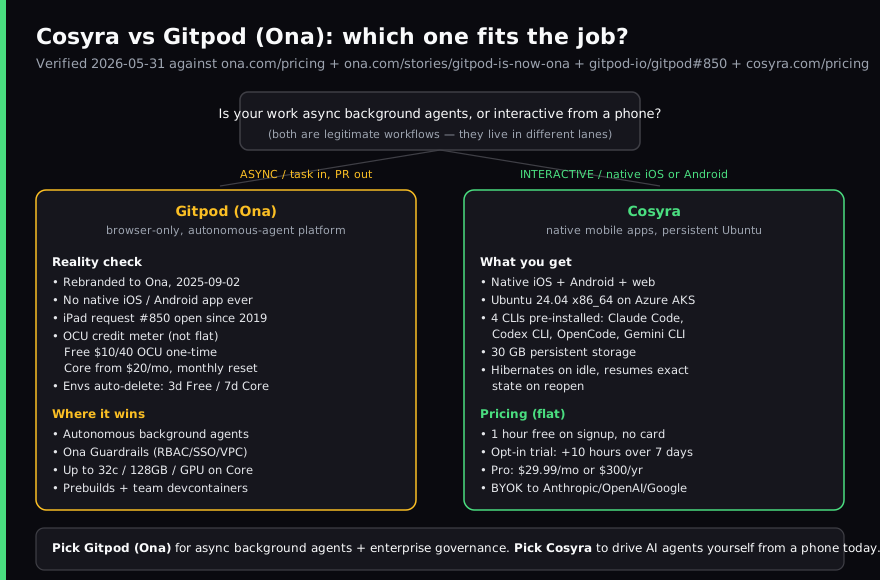
Quick read of the table: if you only look at the cloud-IDE rows (storage, OS support, compute), Cosyra and Ona look like rival CDEs. Look at the AI workflow row and they diverge completely. Ona's center of gravity is async autonomous agents working through a dashboard while you do something else. Ours is interactive CLIs you drive yourself from a terminal on a phone. The right pick depends on which side of that workflow split your day-to-day actually lives on.
Want the interactive-mobile side of this comparison? We ship a persistent Ubuntu container with Claude Code, Codex CLI, OpenCode, and Antigravity CLI pre-installed, on iOS and Android, in about two minutes.
App Store · Google Play · Pricing. Sign up and pick a plan. Eligible new users can start a 7-day free trial in the App Store app.
What happens when you run the same workload on Cosyra and Ona?
We picked a 3,000-line TypeScript project we already had on GitHub, asked an agent to find a retry-backoff function and add jitter, and tried to ship the diff from a tablet without touching a laptop. Same workload, both products, same coffee-shop Wi-Fi, same Saturday afternoon.
On Ona: opened Safari on the iPad, signed in at app.gitpod.io, picked the repo, and got dropped into a browser VS Code workspace. The Files panel and the editor pane sat at desktop widths that pushed our editing area behind the soft keyboard. We could open a terminal pane, but typing multi-line commands into a tabbed editor surface on a touchscreen is the exact friction iPad request #850 has been asking the team to fix since 2019. The autonomous-agent path (start a background task, walk away, get a PR) actually worked from the iPad because the heavy lifting happens server-side and the dashboard is touch-friendly. That is what Ona is really built for now. The interactive editor-on-iPad path is the unshipped one.
On Cosyra: opened the iOS app on the same iPad, tapped into the existing
container, typed git clone, cd, then
claude, pasted the prompt, and accepted the diff with one tap.
Total wall-clock: about three and a half minutes, most of it the clone over
LTE. We then unlocked the Pixel 8, opened the Cosyra Android app, and the
same container was waiting at the same prompt because the container is not
tied to a device. The session below captures the commands.
$ # On the iPad, fresh open of the Cosyra iOS app.
$ uname -m && cat /etc/os-release | head -1
x86_64
PRETTY_NAME="Ubuntu 24.04 LTS"
$ git clone https://github.com/our-team/example.git
$ cd example && claude
> find the retry-backoff function and add jitter
# model reads tree, edits src/retry.ts, shows diff, applied.
$ # Lock iPad. Open Pixel 8 Cosyra Android app.
$ # Same container, same prompt, same files.
$ git status
modified: src/retry.ts
$ git diff --stat && git commit -am "add jitter to retry"
The honest flip side: if our job had been "fire off six refactors in parallel, walk the dog, come back to six pull requests waiting for review," Ona would have crushed our experience. We do not have an equivalent. Our agents run when you tell them to and only while you watch them. The two products optimise for different workflows, and the only honest answer is to say which is which.
Where does Gitpod (Ona) beat Cosyra?
Ona beats Cosyra on autonomous background agents, on enterprise governance, on big-CPU compute ceilings, and on prebuilds for team collaboration. We ship a cloud terminal product and we still think Ona is the right tool for several real jobs. If you sit inside any of the four profiles below, Ona is the honest pick, not Cosyra.
- Autonomous background agents. The headline feature: send an agent a task, walk away, come back to a pull request. Run multiple agents in parallel, each in its own ephemeral kernel-isolated environment. We do not have an equivalent. If "I want code being written while I do something else" is what you actually need, Ona is built for that and Cosyra is not. Read the full pitch at ona.com.
- Ona Guardrails for enterprise governance. RBAC, SSO/OIDC, audit trails, command-level controls, kernel-level isolation, and self-hosted VPC deployment on Enterprise. If you work somewhere that needs to point at a soc2-friendly story for cloud dev environments, Ona has the deeper compliance shape. We are a consumer in-app-purchase product without any of that.
- Bigger compute ceilings. Up to 32 cores / 128 GB RAM / GPU on Core. We do not publish specs at that scale because our sessions are sized for interactive coding, not data-science workloads or 30-minute CI on a single box. If your job needs serious horsepower per workspace, Ona has it.
- Prebuilds + team collaboration baked in. Reproducible team
environments via
devcontainer.jsonandautomations.yml, prebuilds that cache dependencies, team workspaces that everyone joins the same way. The Gitpod team has been refining that workflow for years, and Ona inherits it. We do not ship a team-collaboration story.
Two of these wins come with caveats worth naming. Environments auto-delete after 7 days idle on Core (Ona has no free tier as of 2026-07-04), so the "open a workspace and come back next week" model is not the design intent. Long-lived personal Linux boxes are not what Ona is for. And the OCU credit meter is harder to predict than a flat monthly bill: ~1 OCU for explaining a small codebase, ~8 OCUs for adding a feature to a medium one, so heavy-agent weeks can spike spend in a way flat pricing does not. State the model, not a verdict. Both have real users.
Where does Cosyra beat Gitpod (Ona)?
Cosyra beats Ona on native mobile apps, on interactive AI CLIs you drive from the shell, on persistent per-user Ubuntu state, on cross-device continuity, and on flat predictable pricing. The trade-off for those wins is no autonomous-agent orchestration, no enterprise governance plane, and a smaller per-session compute ceiling. If your work lives in any of the five lanes below, we think we are the better pick.
Native iOS and Android apps, not a browser tab
Ona has never shipped a native app on any store, and the iPad feature request gitpod-io/gitpod#850 has been open since October 2019, almost seven years. The only "Gitpod mobile" artifact in existence is an unofficial side project (gitpod-io/gitpod-mobile-ios) whose own README describes it as something a contributor "is hacking on out of hours and on weekends from time to time." It is not on the App Store; it is not a shipped product. We ship a real iOS app and a real Android app, both backed by the same container, both built to be the primary entry point, not a fallback for when the desktop is not around.
Four interactive AI CLIs, not autonomous-only agents
Ona's agents are async by design: hand them a task description, get a pull request later. That is genuinely great for some workflows and useless for others. When we are actually coding on a train, we want the agent typing in front of us, applying diffs we eyeball, switching between Claude Code for a refactor and Codex CLI for tests and Antigravity CLI for a quick log summary, by typing a different binary name. Our take on which agent to pick for which job lives in Claude Code vs Gemini CLI and Claude Code vs Codex CLI on phone.
Real persistent Ubuntu 24.04, 30 GB, hibernates and resumes
Ona environments auto-delete after 7 days idle on Core (no free tier as of 2026-07-04). The mental model is "fire up a workspace for a project, finish, move on." Ours is different: a persistent per-user Ubuntu 24.04 x86_64 box with 30 GB of storage that survives device loss, hibernates after idle, and resumes exactly where you left off when you reopen the app. "Your Linux box, reachable from anywhere," not "a workspace you fire up for a project."
Same container from any device
Sit on the train, edit on your phone. Get home, open the iPad, same shell history. Pull out the laptop, open the web client, same files, same agent session. Ona's browser-only model technically works from any browser, but there is no native app to hand off to and no design intent around picking up the same workspace on a phone five minutes later. Our cross-device continuity is documented in the mobile coding terminal guide, and the cloud IDE on phone pillar lines Ona up against the four other browser-only cloud IDEs on the same cross-device question.
Flat predictable pricing, BYOK on the AI side
$20/month on Core or $30/month on Pro, with 120 hours of compute included and 30 GB of persistent storage. AI billing is BYOK. You pay Anthropic, OpenAI, or Google directly, no markup. Ona meters compute via OCUs ($20/month entry for Core, OCUs reset monthly, no free tier as of 2026-07-04, and $10 / 40 OCUs as a paid add-on), which is fine for predictable usage and rough for spiky weeks. Different shapes for different budgets.
Opinion a competitor would disagree with
We think interactive matters more than autonomous, at least for the keystroke-by-keystroke part of mobile coding. The Ona bet is that the interesting work is async (task in, PR out, walk away), and that is a legitimate bet for a lot of professional codebases. Our counter-bet is that when you are physically on a train or on a couch with a phone in your hand for thirty minutes, you actually want the agent in your face, not in a Slack thread. Plenty of people will disagree. We built Cosyra around the belief that the people disagreeing haven't actually tried handing keystrokes to Claude Code on a phone for a real afternoon.
Who should pick Gitpod (Ona) instead of Cosyra?
Pick Ona instead of Cosyra if your job is autonomous background agents, if you need enterprise governance, if you need big per-workspace compute, or if your team already runs reproducible devcontainer-based prebuilds. Ona is the right answer for those four profiles, full stop.
Pick Ona if you are one of these profiles
- Async agent operator. Your week is full of "I want this done by tomorrow morning" tasks you'd rather hand to an agent than do yourself. You want parallel agents on parallel branches, then a queue of pull requests to review with coffee. That is Ona's whole pitch and we don't replicate it.
- Enterprise engineering org. You need SSO/OIDC, RBAC, audit trails, command-level controls, self-hosted VPC deployment, and a vendor who answers procurement questionnaires. Ona Guardrails is the right shape for that buyer. Cosyra is a consumer in-app-purchase product and we won't pretend otherwise.
- Heavy per-workspace compute. You need 32 cores or 128 GB RAM or a GPU inside the workspace, and you need it within a few minutes of starting. Ona Core scales there; our sessions are sized for interactive coding.
- Team running on devcontainer prebuilds. Your repo already has
a working
devcontainer.json, your CI burns minutes on dependency installs you'd rather cache, and you want every PR to spin up a reproducible environment in seconds. Ona's prebuild pipeline is built for that and we don't ship one.
We run Ona environments on one of our test laptops specifically because we wanted to write this comparison from first-hand experience. The product is polished, the agent dashboard is genuinely thoughtful, and the enterprise-governance story is a real differentiator. Where it does not fit is our exact use case (interactive coding from a phone or tablet), and that gap is what Cosyra exists to fill. They are not mutually exclusive tools.
How do you try Cosyra if you're coming from Gitpod (Ona)?
You try Cosyra from a Gitpod or Ona background in about two minutes: install
the iOS or Android app, sign in, and land in a fresh Ubuntu 24.04 x86_64
container with four AI CLIs already on PATH. The conceptual jump is "browser
tab full of IDE panels" to "full-screen terminal with an agent you talk to."
Muscle memory for
gp or devcontainer.json doesn't carry over. There is
no equivalent prebuild concept, but if your day was mostly
git, npm, and a single agent, you will feel at
home immediately. The session below captures a first-time install coming
from Ona.
$ # Install Cosyra from App Store or Google Play, sign in,
$ # land in your container.
$ uname -m && lsb_release -d
x86_64
Description: Ubuntu 24.04 LTS
$ # Your agents are already on PATH.
$ which claude codex opencode agy
/usr/local/bin/claude
/usr/local/bin/codex
/usr/local/bin/opencode
/usr/local/bin/agy
$ # Your container persists. No 3-day auto-delete.
$ # Clone a repo and start an agent.
$ git clone https://github.com/you/your-app.git && cd your-app
$ export ANTHROPIC_API_KEY=sk-ant-...
$ claude
The big unlock for most people coming from Gitpod or Ona is the persistence model and the agent-count axis. You stop watching the OCU meter because there isn't one. You stop losing context when a workspace times out because the container hibernates and resumes. You stop reaching for the laptop because the phone app is the primary entry point, not a fallback. And if you sometimes want async background agents on top of all that, you keep your Ona account too. They live in different lanes.
Frequently asked questions
Is Gitpod still called Gitpod, or did it rebrand?
Gitpod rebranded to Ona on 2025-09-02 with the message "Gitpod is now Ona:
your AI software engineer." The product re-centered on autonomous
background agents, "task in, pull request out," while the browser VS Code
IDE continues to ship underneath. We re-verified the rebrand first-hand on
2026-07-04:
curl -sI https://gitpod.io now returns
HTTP/2 200 and loads the app directly. It no longer 308-redirects
to ona.com the way it did right after the rebrand. The sign-in page still lives
at app.gitpod.io. Gitpod is not deprecated; it changed its name and refocused
on agents.
[source: Ona rebrand story, verified 2026-05-31]
Does Gitpod or Ona have a native mobile app?
No. No native iOS, iPadOS, or Android client has ever shipped on any app store, verified 2026-05-31. The repo gitpod-io/gitpod-mobile-ios is a personal weekend hack by a single contributor, not a shipped product. The README itself describes it as something a contributor "is hacking on out of hours and on weekends from time to time." The iPad feature request gitpod-io/gitpod#850 has been open since 2019-10-13 with no native app shipped.
[source: gitpod-io/gitpod#850, verified 2026-05-31]
How much does Ona cost compared to Cosyra?
Ona bills on a credit meter (OCUs, Ona Compute Units). As of 2026-07-04 there is no free tier: Core starts at $20/month with 80–2,200 OCUs that reset monthly, Enterprise is custom, and the $10 / 40 OCU figure is now a paid add-on for extra OCUs, not a free credit. Environments auto-delete after 7 days idle on Core. Re-verified 2026-07-04 against ona.com/pricing. Cosyra is flat $20/month on Core or $30/month on Pro, with 120 hours of compute included and 30 GB of persistent storage that survives device loss.
[source: Ona pricing, verified 2026-05-31]
Can I use Ona from a phone or tablet today?
You can load app.gitpod.io in a mobile browser and the workspace will start, but you are looking at VS Code in a desktop browser tab, not an app built for the device. The Code OSS UI assumes a wide viewport and a trackpad; on iPad Safari panels overlap and the on-screen keyboard covers the editor. iPad-specific support is the open feature request #850 since 2019. Our Gitpod on iPad guide digs into the specifics, and our Ona on a phone guide covers what is and is not usable when you open that same browser workspace on a handset instead.
[source: gitpod-io/gitpod#850, verified 2026-05-31]
What does Ona do that Cosyra does not?
Four real wins. First, autonomous background agents, fire-and-forget "task in, PR out" running in parallel ephemeral environments, a workflow we do not offer (Cosyra is interactive, you-in-the-loop). Second, Ona Guardrails: RBAC, SSO/OIDC, audit trails, command-level controls, and self-hosted VPC deployment on Enterprise. Third, bigger compute ceilings: up to 32 cores / 128 GB RAM / GPU on Core. Fourth, prebuilds + team collaboration baked into reproducible devcontainer-based workspaces. If your job is async agent orchestration with enterprise governance, Ona is the right pick.
[source: ona.com, verified 2026-05-31]
What does Cosyra do that Ona does not?
Five. We ship native iOS and Android apps purpose-built to be a terminal on a phone. Ona is browser-only and has never shipped an app. We pre-install four AI coding CLIs (Claude Code, Codex CLI, OpenCode, Antigravity CLI) you drive interactively from the shell. Ona's agents are async. Our container is a persistent Ubuntu 24.04 box with 30 GB of storage that survives device loss and hibernates on idle. Ona environments auto-delete after 7 days idle (no free tier as of 2026-07-04). We use BYOK so you pay Anthropic, OpenAI, or Google directly. Ona meters compute through OCUs. And our pricing is flat, $20 or $30/month, with no surprise per-hour spend.
[source: Cosyra pricing + product page]
Is Cosyra an Ona alternative?
Only on the interactive-mobile axis. If your goal is async "task in, PR out" background agents with enterprise governance and big-CPU prebuilds, Cosyra is not an alternative and we will not pretend to be. Read ona.com and pick Ona. If your goal is to drive an AI agent yourself from a phone or tablet on the train, the couch, or the school pickup line, Cosyra is the direct answer: native iOS and Android apps, four CLIs pre-installed, a persistent Ubuntu container that hibernates and resumes. The two products live in different lanes of the same market.
Pre-installed Claude Code, Codex CLI, OpenCode, and Antigravity CLI. We run them in a real x86_64 Ubuntu container, reached from a native iOS or Android app. Two-minute setup.
Gitpod on iPad (now Ona) · Cosyra vs Firebase Studio · Cosyra vs Codespaces on mobile · See pricing. Sign up and pick a plan. Eligible new users can start a 7-day free trial in the App Store app.