Firebase Studio on a phone is the wrong question. It is a desktop browser IDE with no native iOS or Android app, no real mobile layout, and a sunset date of March 22, 2027 on Google's own migration page. The page opens in Mobile Safari or Chrome the way any web app opens, but the file tree, command palette, and editor panes were drawn for a mouse and a wide window. If your goal is to actually code on a phone, on a train, on the couch, in a waiting room, the honest answer is a native app plus a persistent cloud Linux box, which is what we build at Cosyra.
This guide separates the two questions people are actually typing into Google, because conflating them is where most write-ups go wrong. The first is "can Firebase Studio build mobile apps?" Yes, it builds Flutter, React Native, and Expo. The second is "can I sit on a phone and use the Firebase Studio IDE?" That is the gap. We cover what is shipped, what is only on the roadmap, what the 2027 sunset means for anyone learning it now, and the setup that does work on a phone today. For the tablet-shaped version of the same question see our Firebase Studio on iPad guide; for the head-to-head with the alternative shape, our Cosyra vs Firebase Studio comparison walks the feature table and pricing side by side; and for the wider map of agent coding on mobile see the AI coding agents on mobile pillar.
Does Firebase Studio work on a phone?
Loading-wise, yes. It is a web app, so the URL opens in Mobile Safari or Chrome. Usability-wise, no. Firebase Studio is built on Code OSS (the open core of VS Code) running inside a Google Cloud VM, with Gemini wired in. It is a desktop IDE shape: file tree on the left, editor in the middle, panels docked below, command palette designed for a keyboard. Shrunk to a phone screen, those affordances collapse. Targets are too small for thumbs, the file tree eats most of the width, and there is no native software-keyboard integration with the editor's command palette. The same desktop-IDE-shrunk-to-a-phone problem shows up in plain VS Code on your phone (vscode.dev), same Monaco editor and command palette, and on the browser surface it drops the integrated terminal entirely.
There is also no native client. We checked the App Store and Google Play on 2026-05-30 and there is no first-party "Firebase Studio" IDE app from Google. The Firebase iOS SDK on GitHub is a backend library you add to apps you build, easy to misread as "there's an iOS app" but it is not a Studio client. The product page confirms the architecture: "right from your browser," "accessible from anywhere," and a single "Open Firebase Studio" button. Browser is the only door.
The most useful data point we have is from someone who actually tried it. When Firebase Studio launched in April 2025, a long-time mobile prototyper posted on Hacker News that he opened it in Mobile Safari on his phone, and the preview panel rendered blank. He ended up switching back to a desktop browser. His exact frustration was that he does most of his prototyping on a phone and the tool did not meet him there. That single comment captures the gap better than a spec sheet would, and a year later the same gap exists.
What part of Firebase Studio actually touches mobile?
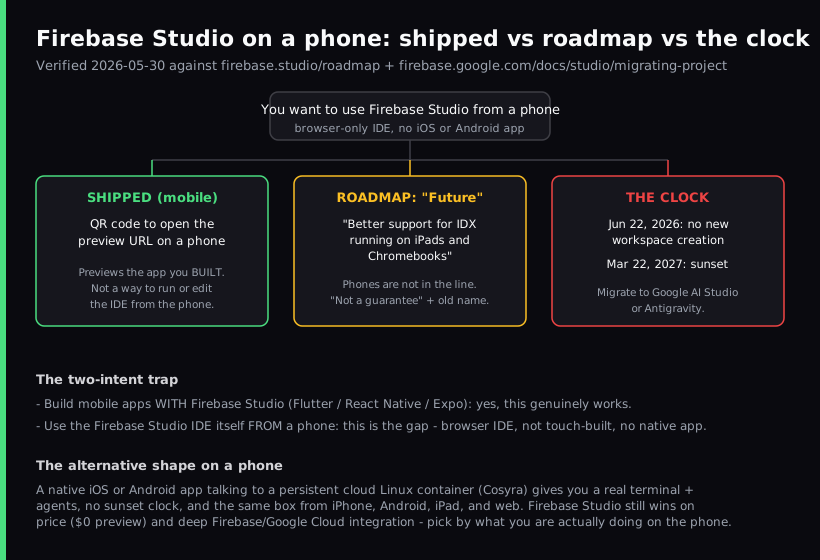
Exactly one thing, and it previews output, not the IDE. From the official Firebase Studio roadmap, the only mobile-related item marked Completed is verbatim:
"QR Code to open preview URL on mobile device."
You build an app on your desktop, the IDE shows a QR code, you scan it with your phone, the running preview of the app loads on the phone. Useful, but it is the inverse of what mobile coders want. The phone receives the artifact. It does not give you a way to write or edit code from the phone. Combined with Expo Go phone preview for React Native apps, this is the full extent of Firebase Studio's mobile story today.
Is iPad or Chromebook support coming?
There is a roadmap entry, but Google has labelled it "Future" with an explicit non-guarantee disclaimer. From the same roadmap page, verified first-hand on 2026-05-30:
"Better support for IDX running on iPads and Chromebooks", status: Future.
Two tells make this look like a low-priority legacy entry rather than active work. First, it is still called "IDX," the deprecated Project IDX name, which has not been refreshed since the merger. Second, the roadmap carries a blanket disclaimer that it is "not exhaustive, nor a guarantee we'll complete everything." Pair that with the sunset date in the next section and the realistic read is that proper iPad and Chromebook support may never ship, let alone phone-specific support, and phones are not in the line at all. We think the safe planning assumption is that Firebase Studio will remain a desktop browser product through its remaining lifetime, and the Firebase team has not contradicted that publicly.
Firebase Studio sunsets on March 22, 2027
This is the fact that should weigh on any mobile decision. Google's migration page states plainly that Firebase Studio is sunsetting on March 22, 2027, and that as of June 22, 2026 new workspace creation and user signup are disabled. That second date has already passed, so this is no longer a clock ticking in the future: a new reader can no longer sign up or create a workspace at all. The recommended paths off the product are Google AI Studio for browser-based prototyping and Antigravity for code-first, agentic development. The Antigravity IDE is desktop-only. See our Antigravity on phone guide for the same browser-only-with-no-mobile-app pattern repeating in the recommended migration target. Jules, Google's asynchronous coding agent, repeats it once more: you can trigger a task from a phone browser, but it returns a pull request rather than a terminal, and there is no official Jules app either.
Spending weeks learning a tool's quirks for a phone workflow that the tool does not really support, on a product scheduled to shut down, is not where your setup time should go. That is an opinion the Firebase team would likely push back on, and we will hold it anyway. The phone keyboard is fine for agent-driven coding when the surface is a real native terminal talking to a real Linux box. Most people who disagree haven't tried it. They have only tried the laptop IDE squished into a browser tab, and that experience is correctly hopeless. The two situations get conflated, and the conclusion that "phones are bad for coding" inherits from the wrong tool.
What does Firebase Studio cost on mobile?
The Studio itself is free during its availability. Google's pricing page states "Access to Firebase Studio is available at no cost." The only paid lever is workspace count: 3 workspaces without the Google Developer Program, 10 on the Standard tier, and 30 on the paid Premium tier. Without Premium there is also a combined cap of 2 workspaces across Flutter, React Native, and Expo project types. Some integrations like Firebase App Hosting push the linked Firebase project onto the pay-as-you-go Blaze plan, which can incur charges beyond the Studio quota.
That free price is the one axis where Firebase Studio clearly beats us, and we want to name it before the alternative section: $0 for Studio access vs our subscription, which starts at $20/month. If cost is the deciding factor and you are willing to live with a desktop browser, Firebase Studio is the cheaper box. The trade-off you accept is that "mobile" means previewing built apps, not editing them.
How do you actually code on a phone instead?
The pattern that works on a phone is the one Firebase Studio is missing: a native iOS or Android app talking to a persistent cloud Linux environment. The phone's job is to be a good client to a real Linux box, not to pretend it can host a desktop IDE in a Safari tab. Once you accept that, the "phones are bad for coding" complaints mostly dissolve. You are typing short prompts to an agent and reviewing its output, not hand-editing 300 lines of JSX with a thumb.
That is what we build. The Cosyra iOS app and the Cosyra Android app give you a persistent Ubuntu 24.04 container with Claude Code, Codex CLI, OpenCode, and Antigravity CLI already installed, 30 GB of storage, and hibernation that resumes exactly where you left off. The same container is reachable from iPhone, Android, iPad, and the web, so we start a task on a phone on the train, pick it up on a laptop at a coffee shop, and finish it on an iPad on the couch without re-cloning anything.
Step 1: Install Cosyra from the App Store or Google Play
Open the App Store on iPhone or Google Play on Android and install Cosyra. Sign in with Apple, Google, or email. The app provisions a fresh Ubuntu container on first launch.
Step 2: Add your model API key
Cosyra is bring-your-own-key, so you pay Anthropic, OpenAI, or Google directly rather than through us. In the terminal:
$ # Persists across sessions and device switches
$ echo 'export ANTHROPIC_API_KEY="sk-ant-your-key-here"' >> ~/.bashrc
$ source ~/.bashrc
$ claude --version
Claude Code (latest)
Step 3: Run an agent
Clone a repo and start a session:
$ git clone https://github.com/your-org/your-project.git
Cloning into 'your-project'...
$ cd your-project
$ claude
Claude Code (latest)
Type your prompt, or type "/" for commands.
> Add a health-check endpoint and a test, then run the suite.
Try it on your phone. Sign up and pick a plan. Eligible new users can start a 7-day free trial in the App Store app. App Store / Google Play / Pricing details
How do the phone coding options compare?
Lined up against what matters on a phone, a real native app, a persistent box, and whether the tool is on a deprecation clock, the options sort out clearly. The table covers the realistic paths as of 2026-05-30.
| Feature | Firebase Studio (Safari) | Cosyra (iOS / Android app) | Codespaces (Safari) |
|---|---|---|---|
| Native phone app | No (browser only) | Yes (iOS + Android) | No (browser only) |
| Real mobile UX shipped | No (desktop layout) | Yes | Partial (web editor) |
| Persistent environment | Ephemeral workspaces | Ubuntu 24.04, 30 GB | Per-repo, idle timeout |
| AI agents | Gemini (in-IDE) | 4 CLIs pre-installed | Copilot (in-IDE) |
| Builds mobile apps | Yes (Flutter/RN/Expo) | Yes (your own toolchain) | Yes (your own toolchain) |
| API key model | Gemini metered | BYOK (pay provider) | GitHub plan |
| Free tier | Yes (3 workspaces) | None. 7-day trial in the App Store app (eligible new users) | Monthly free hours |
| Being sunset | Yes (Mar 22, 2027) | No | No |
| Cost | $0 (Premium for caps) | From $20/mo | Usage-based |
Where Firebase Studio wins
An honest comparison names what the other tool does better, so here it is with no hedging. Firebase Studio beats Cosyra on these axes, and if they describe your situation you should use it on a laptop and accept that "mobile" means previewing built apps on a phone:
- Price. Firebase Studio is free during its availability (3 workspaces) against our subscription, which starts at $20/month. On cost alone, it wins.
- Firebase and Google Cloud integration. Emulators, App Hosting deploy, and Blaze billing all live in one place. We do not replicate that, and if your whole backend is Firebase, that integration is worth a lot.
- The App Prototyping agent. Its no-code prompt-to-app flow (Next.js web output) is a lower-floor workflow than our terminal- first agents, and is genuinely better for non-developers prototyping a web app.
- In-browser Android emulator. Testing a Flutter or React Native build without leaving the browser is a real convenience we do not offer.
Who should pick which?
Here is the decision framework we would give a friend, with the phone question front and center.
- Stay on Firebase Studio if you already created a workspace before June 22, 2026, you are on a laptop or desktop, and you are finishing a Flutter / React Native / web app whose backend is Firebase. Existing workspaces keep working until the March 22, 2027 sunset, so it is fine to ship a prototype you have already started. "Mobile" for you means scanning a QR code to preview the built app on a phone. New users no longer have this option: signup and new workspace creation are closed.
- Pick Cosyra if the device in your hand is an iPhone or Android phone, you want a real terminal and AI coding CLIs you drive yourself from the device, and you want a persistent box that is not on a shutdown clock and follows you across iPhone, Android, iPad, and web.
- If you are new to Firebase Studio, you cannot start it at all anymore: signup closed on June 22, 2026. Google routes new non-developers who want prompt-to-app prototyping to Google AI Studio, and code-first users to Antigravity. If your real goal was coding from a phone, neither of those ships a native mobile app either, which is the gap Cosyra fills.
Frequently asked questions
Does Firebase Studio work on a phone?
Not in any practical sense. Firebase Studio is a browser-only IDE built for a desktop browser, with no native iOS or Android app. A developer who tried it in Mobile Safari at launch said it "clearly wasn't designed with mobile in mind" and that the preview panel rendered blank until he switched back to a desktop browser. It technically loads on a phone, but you cannot meaningfully edit code in it on that surface.
[source: Hacker News, "Firebase Studio" launch thread]
Is there a Firebase Studio app on the App Store or Google Play?
No. Firebase Studio has no native client app on the App Store or Google Play. The "Firebase" iOS SDK on GitHub is a backend library you add to apps you build, not a Studio IDE client. The official product page confirms the architecture: it loads "right from your browser" with a single "Open Firebase Studio" button.
[source: Firebase Studio marketing site]
Is Firebase Studio being discontinued?
Yes, and it is already closed to new users. Google's migration page states Firebase Studio is sunsetting on March 22, 2027, and that as of June 22, 2026 new workspace creation and user signup are disabled. If you do not already have a workspace, you cannot start one; Google points you to Google AI Studio for browser prototyping or Antigravity for code-first agentic development instead. For anyone choosing a tool to invest mobile time in right now, Firebase Studio is no longer an option you can pick up.
[source: Firebase Studio sunset and migration, official docs]
How do I use Firebase Studio from my phone in the meantime?
The only mobile-touching feature Google has shipped is preview, not editing. From the official roadmap, marked Completed: "QR Code to open preview URL on mobile device." You scan a code on your desktop and the app you built opens on your phone. That previews output. It is not a way to drive the IDE itself from the phone.
[source: Firebase Studio official roadmap]
Is Firebase Studio the same as Project IDX?
Yes. Firebase Studio is the renamed and merged successor to Project IDX (combined with Gemini in Firebase). Google's own docs confirm "Project IDX is now part of Firebase Studio," and existing IDX projects were migrated automatically. The roadmap still uses the old "IDX" name in the iPad/Chromebook line, a tell that the entry is a legacy item.
[source: "Project IDX is now part of Firebase Studio", official docs]
How many Firebase Studio workspaces can I create for free?
Three. Firebase Studio access is free during its availability, and the only paid lever is workspace count: 3 workspaces without the Google Developer Program, 10 on the Standard tier, and 30 on the paid Premium tier. Without Premium there is also a combined cap of 2 workspaces across Flutter, React Native, and Expo project types.
tl;dr
Firebase Studio is a browser-only IDE with no native iOS or Android app. It opens in Mobile Safari or Chrome but is not built for it, the only shipped mobile feature is a QR code that previews built apps (not the IDE), iPad and Chromebook support are unshipped roadmap items Google labels "Future," and the whole product sunsets March 22, 2027 (signup and new workspaces already closed as of June 22, 2026, so new users cannot start it). It does build mobile apps, so existing workspaces can still use it on a laptop for that. To actually code on a phone, use a native iOS or Android app on a persistent cloud Linux box. That is Cosyra, with four AI CLIs pre-installed and no shutdown clock.
App Store / Google Play. Sign up and pick a plan. Eligible new users can start a 7-day free trial in the App Store app. See pricing.
For the wider picture, our guide to AI coding agents on mobile maps every agent across phone and tablet, and the mobile coding terminal pillar covers the terminal-on-a-device decision end to end. If you are weighing the tablet version of this same question, see Firebase Studio on iPad, and for the comparable browser-only-with-no-mobile-app pattern in another Google product see Antigravity on phone. The same shape shows up in the self-hosted-IDE world too: Coder's official iOS instructions hand iPhone users off to the iSH emulator instead of shipping an app, which we walked through in Coder on iPhone. For the full cluster view, Firebase Studio, Coder, Gitpod (Ona), Codespaces, and Replit all benchmarked as cloud IDEs you'd actually open from a phone, see the cloud IDE on phone pillar.
Get a real dev environment on your phone in 3 minutes. Install Cosyra, add your API key, run an agent in a persistent Ubuntu container.