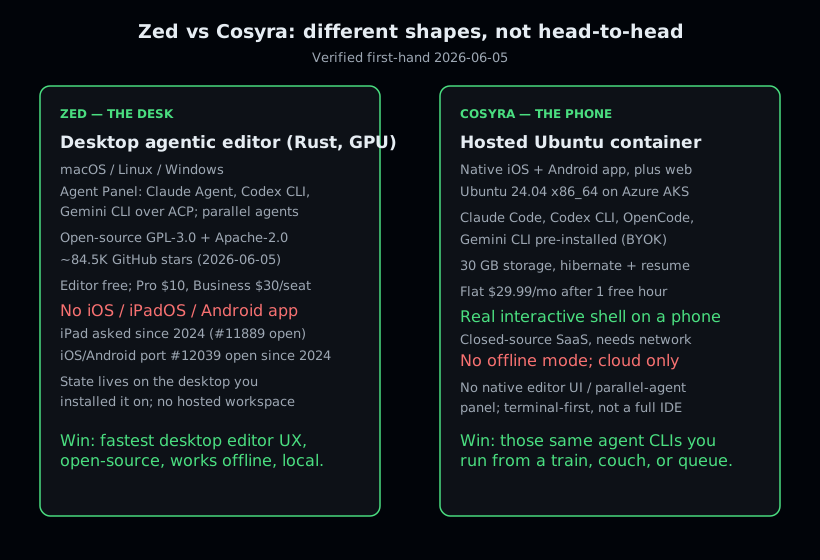
Short answer. The Cosyra vs Zed question is really two different shapes, not a head-to-head. Zed is the fastest agentic editor on the desktop: open-source, GPU-rendered, with an Agent Panel that runs Claude Agent, Codex CLI, and Gemini CLI side-by-side over the Agent Client Protocol. But it runs on macOS, Linux, and Windows only, with no mobile app of any kind. Cosyra is a hosted Ubuntu container reached from native iOS and Android apps, with Claude Code, Codex CLI, OpenCode, and Gemini CLI pre-installed. If you are at a desk, use Zed. If the device in your hand is a phone, we think Cosyra is the better fit.
We wrote this after running the same agent loop both ways: drive a coding agent through Zed's Agent Panel on a Mac at a desk, then drive the same kind of session from a cloud container on an iPhone in a doctor's waiting room. Both are good. Only one of them runs when there is no laptop in front of you.
Quick decision: pick the path that matches your situation:
- I want the feature-by-feature breakdown → 13-attribute comparison table for 2026
- I want to know where Zed genuinely wins → five things Zed does better, with sources
- I'm leaning toward Zed. Am I right? → honest decision framework (with a "try Zed first if…" subsection)
- I want those agents on my phone today → two-minute Cosyra setup on iOS or Android
tl;dr
Use Zed if you code at a desk and want one of the fastest native editors on the planet, value open-source and auditability, or want a parallel-agent panel inside a full editor UI. Use Cosyra if you want to actually run those same agent CLIs from a phone, already installed in a container that follows you across devices. They are different tools for different places.
App Store · Google Play. 1 hour free on signup. Extend with a 10-hour, 7-day trial. No credit card.
This post was written by the Cosyra team. We compared Cosyra against Zed based on hands-on testing of both, Zed on macOS and Linux, Cosyra on iPhone and Android, plus first-hand reads of zed.dev, the Zed GitHub repository via the GitHub API, and our internal Zed factsheet. Zed facts and version numbers were re-verified first-hand on 2026-06-05.
Came here because you want Zed on your phone and found there's no app? We ship a persistent Ubuntu 24.04 container with Claude Code, Codex CLI, OpenCode, and Gemini CLI pre-installed, reached from a native iOS or Android app. Two-minute setup.
App Store · Google Play · Pricing. Sign up, 1 hour free, no credit card. Extend with a 10-hour, 7-day trial when you want more.
How do Cosyra and Zed compare feature by feature?
The core difference in Cosyra vs Zed is the device. Zed is a desktop editor with an agent panel that runs on a machine you own; Cosyra is a hosted Linux container you reach from a phone. Zed's editor is free and its AI is metered in predictions and hosted tokens; Cosyra charges a flat rate for the machine and storage. The table below lines them up on thirteen attributes as of 2026-06-05.
| Feature | Cosyra | Zed |
|---|---|---|
| Pricing | $29.99 / month Pro, or $300 / year | Editor free; Pro $10/mo, Business $30/seat/mo |
| Free tier | 1 hour on signup + 10-hour, 7-day trial, no credit card | Personal $0: 2,000 edit predictions, unlimited with your own keys |
| OS support | iOS, Android (native apps), plus web | macOS, Linux, Windows; no mobile app |
| AI agents pre-installed | Claude Code, Codex CLI, OpenCode, Gemini CLI in the container | Agent Panel runs Claude Agent, Gemini CLI, Codex CLI over ACP |
| Persistent storage | 30 GB per user, hibernates and resumes in place | Your local disk; nothing hosted to persist between machines |
| Offline capability | No: the container is in the cloud, needs a network | Yes: runs on your local machine, works offline |
| Container sandboxing | Per-user isolated Ubuntu 24.04 container on Azure AKS | None: runs directly on your host OS (or SSH/remote targets) |
| Port forwarding | HTTPS tunnels to container ports | Local ports directly; remote via SSH/remote-dev you configure |
| File sync across devices | Same container from iPhone, Android, and web | Machine-bound; tied to whatever desktop it's installed on |
| Max session length | Persistent; hibernates after 10 min idle, resumes | As long as your machine stays on and Zed stays open |
| API key / billing model | BYOK: pay Anthropic / OpenAI / Google directly | BYOK agents free; Zed-hosted models metered on paid tiers |
| Open-source status | Closed-source SaaS, orchestration proprietary | GPL-3.0 + Apache-2.0 (NOASSERTION on GitHub) |
| Runs on a phone | Yes, that is the entire point | No; no iOS / iPadOS / Android build exists |
Want the phone-shaped version of Zed's agent loop? Native iOS and Android, Ubuntu 24.04, Claude Code and Codex CLI already on the PATH, two-minute setup.
App Store · Google Play · Pricing. Sign up, 1 hour free, no credit card. Extend with a 10-hour, 7-day trial when you want more.
What actually happens when you try to use Zed on a phone?
Nothing installs. We opened the App Store and the Play Store and searched for Zed; there is no Zed editor app to download, because Zed ships installers for Mac, Linux, and Windows only. There is no web build of the editor either, the way some IDEs offer a browser fallback. Zed has remote-development and SSH features, but the editor is still a native app running on a desktop you own; the phone is, at best, a thin client to a machine you keep powered on somewhere else.
So the real test is not "Zed on a phone vs Cosyra on a phone"; only one of
them exists on a phone. The honest test is: you want the thing Zed gives you
at a desk, an agent panel where you describe a change and an agent edits
files and runs commands, while you are away from your laptop. We did exactly
that on an iPhone from a waiting room. We opened the Cosyra iOS app, dropped
into a full-screen Ubuntu shell, typed claude, pasted an
Anthropic key, described a refactor, approved the diff, and ran
git commit && git push. The agent did the typing; our
job was to prompt, review, and approve. That loop is the part of Zed people
miss on mobile, and it is the part a cloud container reproduces, because two
of Zed's three ACP agents (Claude Agent and Codex CLI) are the very CLIs we
pre-install.
The honest caveat runs the other way too. On a Mac, Zed is a genuinely better editor than a plain shell in our container. Its multibuffer, language-server integration, and the parallel-agent panel added in Zed 1.0 (2026-04-29) are real ergonomic wins at a desk. We are not claiming Cosyra replaces Zed on a laptop; it does not, and it is not trying to. The claim is narrower and, we think, more useful: when the laptop is not there, Zed gives you nothing to install on the phone, and a container gives you a shell with the same agents.
Where does Zed beat Cosyra?
Zed beats Cosyra on desktop editor UX, open-source auditability, a free editor, local-first offline operation, and a purpose-built parallel-agent panel. We ship a product that competes for the same agentic-coding job, and Zed is still the better answer for several real situations. Here are five, each backed by a first-hand source.
- A sharper desktop editor. A GPU-rendered native editor with
multibuffer editing, language-server support, and an agent panel beats a shell
plus
vimin a mobile container. At a desk, this is a real productivity gap in Zed's favor, and we use editors like Zed ourselves when we are on a laptop. - Open-source and auditable. Zed's client is dual-licensed GPL-3.0 + Apache-2.0. You can read the Rust source, build it yourself, and audit what it does. Cosyra's orchestration is closed-source SaaS on Azure. If auditability is non-negotiable for you, that is a clear point for Zed, not us.
- Parallel agents in one window. Zed 1.0 made running multiple
agents in a single window a headline feature. Cosyra runs agents in shell sessions
(you can split with
tmux), but Zed has a purpose-built UI for parallel agent work that a terminal does not match. - Free to use the editor. Zed's editor is $0 and stays free with your own API keys or external agents; only Zed-hosted models are metered. If you mostly want a fast editor and bring your own keys, you can stay on the free tier indefinitely. Cosyra's compute past the free hour and trial is a $29.99/month subscription for the hosted machine.
- Local-first and offline. Zed runs on your machine, so it works on a plane with the Wi-Fi off, against local files, with no network round-trip. Cosyra's container lives in the cloud; no connection means no terminal. This is a genuine trade-off we name openly: a local tool wins the moment the network is gone.
Where does Cosyra beat Zed?
Cosyra beats Zed on the one axis Zed does not contest: it runs on a phone. Add to that AI CLIs pre-installed, a persistent workspace that follows you across devices, and not needing to supply your own machine. These are different-shape strengths, so we are precise about each.
A real terminal on a phone, not a desktop-only editor
Cosyra gives you an interactive Ubuntu 24.04 shell from the iOS and Android apps. Zed has no mobile build at all; developers have asked for iPad since 2024 (issue #11889 is still open with 39 comments) and a general iOS/Android port since 2024 (#12039, still open). We did not wait for that; we built the phone-native shell that runs the same agents Zed drives over ACP.
Claude Code, Codex CLI, OpenCode, and Gemini CLI pre-installed
On a fresh Cosyra container, four agent CLIs are already on the PATH. You
export a provider key and type claude. Zed's Agent Panel is
excellent, but it runs those agents inside a desktop editor you have to be
sitting at. We pre-install the standalone CLIs because setup friction is the
main thing that kills agent-driven mobile coding; nobody wants to npm install a toolchain one-handed on a phone keyboard.
$ uname -m
x86_64
$ cat /etc/os-release | head -1
PRETTY_NAME="Ubuntu 24.04 LTS"
$ which claude codex opencode gemini
/usr/local/bin/claude
/usr/local/bin/codex
/usr/local/bin/opencode
/usr/local/bin/gemini
$ export ANTHROPIC_API_KEY=sk-ant-...
$ claude
A persistent workspace that follows you across devices
Cosyra containers carry 30 GB of persistent storage and hibernate after 10 minutes idle, resuming in place on next open. The same container is reachable from your iPhone, your Android tablet, and the web: clone a repo on the couch, pick it up from the waiting room, finish at your desk, all in one shell. Zed is tied to whatever desktop machine it is installed on; its state lives there, and there is no hosted workspace that travels with you.
You don't have to supply the machine
Zed still needs a computer, your local machine, or an SSH/remote target you own and keep running. Cosyra is the machine. There is nothing to leave powered on at home and SSH back into; the container is the thing you connect to. For a developer whose only always-available device is a phone, that removes the biggest hidden dependency in every "use Zed remotely" workaround.
An opinion Zed's team would push back on
Here is where we disagree with the prevailing editor-vendor view. Zed not shipping a cramped mobile editor is a defensible call; a tiny multibuffer on a phone screen would be bad. But the conclusion most desktop editor teams draw, that serious agent-driven work belongs at a desk, is the part we think is wrong. When the agent is doing the typing, the human's job shrinks to prompt, review, approve, and that job fits a phone fine. We think the phone keyboard is fine for agent-driven coding, and most people who disagree have not actually tried driving an agent from a real shell on a train. Zed's team would likely argue the editor is where the work belongs; we built Cosyra because we don't think the desk is the only place the work happens.
Who should pick Zed instead of Cosyra?
Pick Zed if you are a desktop-primary developer who wants one of the fastest editors on your laptop, you value open-source and want to audit or self-build your tools, you want a parallel-agent panel inside a full editor UI, or you frequently work offline. We use fast native editors ourselves at our desks and Cosyra from our phones; they are not mutually exclusive.
Try Zed first if you are one of these profiles
- Desktop-primary developer. You code from a laptop or workstation 95% of the time. Zed's speed, multibuffer, and parallel-agent panel make your daily editor better in ways a mobile container does not try to. For this shape of use, Zed is the right answer, not us.
- Open-source requirement. You need to audit or self-build your tooling, or your organization forbids closed-source SaaS in the toolchain. Zed's GPL-3.0 + Apache-2.0 source is a hard requirement Cosyra cannot meet.
- Frequently offline. You work on planes, in dead zones, or against local-only files. A local editor beats a cloud container the moment the network drops. If a meaningful share of your work is offline, Zed wins.
We use a fast native editor when we are sitting at a desk and want the nicest editing surface on the machine. We use Cosyra when the only device we have is a phone. Different tools, different places. Choose by where you are, not by which is "better."
How do you try Cosyra if you're coming from Zed?
You try Cosyra from a Zed background in about two minutes: install from the App Store or Google Play, open the app, and you land in a fresh Ubuntu 24.04 x86_64 container with Claude Code, Codex CLI, OpenCode, and Gemini CLI already on PATH. The agents you drive from Zed's Agent Panel translate directly, two of the three ACP agents (Claude Agent and Codex CLI) are the same CLIs here; the difference is there is no install step and no machine to keep powered on. The session below shows the commands we run on a fresh install.
$ # Install Cosyra from the App Store or Google Play,
$ # open the app, drop into the container shell.
$ uname -m
x86_64
$ cat /etc/os-release | head -1
PRETTY_NAME="Ubuntu 24.04 LTS"
$ git clone https://github.com/you/your-repo
$ cd your-repo
$ export ANTHROPIC_API_KEY=sk-ant-...
$ claude
# The agent is already on the PATH. No install, no machine to keep on.
If you wrap long Zed sessions in a way that survives interruptions, the
Cosyra equivalent is tmux: start a named session, detach, and
reattach after your phone locks or the connection drops. We walk the whole
flow in our
guide to running Zed's agents on your phone when Zed has no app, and the broader setup in
How to Run Claude Code on Your Phone. For the full map of mobile coding options, the
AI coding agents on mobile pillar lays out every route. If your real comparison set is other desktop tools, the
same desk-vs-phone logic shows up in
Cosyra vs Warp,
Cosyra vs VS Code for the Web, and
Cosyra vs Kiro. AWS's spec-driven
agentic IDE is desktop-only too, with the same no-mobile-build gap as Zed.
The same wall hits the editor formerly called Windsurf, now Devin Desktop:
our
Cosyra vs Windsurf head-to-head
covers the desktop-only trade after the 2026-06-02 rename, and
Devin Desktop on your phone
covers running its agents from a phone. ByteDance's Trae is the same shape, a
proprietary VS Code fork that only ships desktop builds, and we compare it in
Cosyra vs Trae.
Frequently asked questions
Can you run Zed on an iPhone or Android phone?
No. As of 2026-06-05, Zed's download page lists macOS, Linux, and Windows only. There is no native iOS, iPadOS, or Android build of any kind. The editor is a local desktop app, not a hosted workspace you reach from a phone. To get the agent loop Zed gives you at a desk while you are on a phone, you run the same agent CLIs in a cloud Linux container. That is what we built Cosyra to be.
[source: Zed download page: macOS, Linux, Windows only, verified 2026-06-05]
Is Zed coming to iPad or Android?
Not on any committed roadmap. The iPad request, GitHub issue #11889, has been open since 2024-05-16 with 39 comments as of 2026-07-10; the broader iOS/Android port request, issue #12039, has been open since 2024-05-19 with 35 comments. Both still carry the platform:general label and neither has a roadmap commitment two years on. We are not predicting Zed will never ship mobile, only that it has not, and the public signals do not point to a near-term release.
[source: GitHub issue #11889 "iOS support for iPad", open since 2024-05-16]
Is Zed open source?
Yes. Zed's client is dual-licensed: LICENSE-GPL is GPL-3.0 and LICENSE-APACHE is Apache-2.0, which is why GitHub's detector reports NOASSERTION rather than a single SPDX id. The repo had about 86,500 stars when we checked on 2026-07-05, latest release v1.9.0. This is a real trust signal a closed-source SaaS cannot match, and we say so plainly above. Cosyra's orchestration is closed-source; if auditability is your top requirement, that is a point for Zed.
[source: Zed GitHub repo, dual GPL-3.0 + Apache-2.0 license, verified 2026-06-05]
Does Zed run AI agents like Claude Code?
Yes, at the desk. Zed's Agent Panel runs external agents in the background and drives them over the Agent Client Protocol (ACP). Zed's own docs say it runs Gemini CLI in the background and talks to it over ACP; the supported set includes Claude Agent, Gemini CLI, Codex CLI, and GitHub Copilot. Three of those are the same CLIs Cosyra pre-installs. The difference is the surface: Zed runs them inside a desktop editor; Cosyra runs them in a shell you reach from a phone.
[source: Zed docs, external agents over ACP, verified 2026-06-05]
How much does Zed cost compared to Cosyra?
Zed's editor is free; its paid tiers meter AI: Personal is $0 (2,000 edit predictions, unlimited with your own keys or external agents), Pro is $10/month (more predictions plus $5 of Zed-hosted tokens), and Business is $30/seat/month. Cosyra is a flat $29.99/month after a free hour. These buy different things: Zed's price meters AI tokens on an editor you run on your own machine, and Cosyra's price is the hosted machine and 30 GB of storage itself. It is not a like-for-like dollar comparison, so we do not present it as one.
[source: Zed pricing page, verified 2026-06-05]
What is the best way to run Zed's agents from a phone?
Two honest paths. If you already own a Mac, Linux box, or Windows PC that stays on, install Zed there and reach it over SSH or Zed's remote-development feature from a phone terminal app. If you do not want to keep a machine running, use a hosted container: Cosyra gives you an Ubuntu 24.04 shell from a native iOS or Android app with Claude Code, Codex CLI, OpenCode, and Gemini CLI pre-installed. We wrote the full setup in our zed on phone guide, and the tablet version in our Zed on iPad guide.
[source: GitHub issue #12039 "iOS/Android Port", open since 2024-05-19]
Pre-installed Claude Code, Codex CLI, OpenCode, and Gemini CLI. We run them in a real x86_64 Ubuntu container, reached from a native iOS or Android app. Two-minute setup.
Zed on phone · Cosyra vs Warp · AI coding agents on mobile · See pricing. Sign up, 1 hour free, no credit card. Extend with a 10-hour, 7-day trial when you want more.